

Water and Wastewater: The Overlooked Burden on Private Landowners
Water supplies are taken for granted in Scotland because Scottish Government figures show that only 3% of Scotland’s population get their drinking water from private water supplies, not owned or operated by Scottish Water. Most of these people are in remote and rural areas and their water comes from sources like springs, burns, lochs or boreholes. In a similar way, and more extensively, hooking into a sewerage main is, at the very best, atypical outwith an urban setting.
Private water supplies in Scotland were first regulated under the Water (Scotland) Act 1980. This act established the foundational framework for ensuring the quality and safety of drinking water. The regulations have since been updated, with significant amendments in 2006 and 2017 to align with European directives and enhance water quality standards. What none of these regulations takes into consideration is the practical side of, or indeed the costs involved in, ensuring that private water supplies are compliant. Similarly, with private wastewater treatment, there is a mismatch in regulation in respect of privately owned historical infrastructure and discharge agreements.
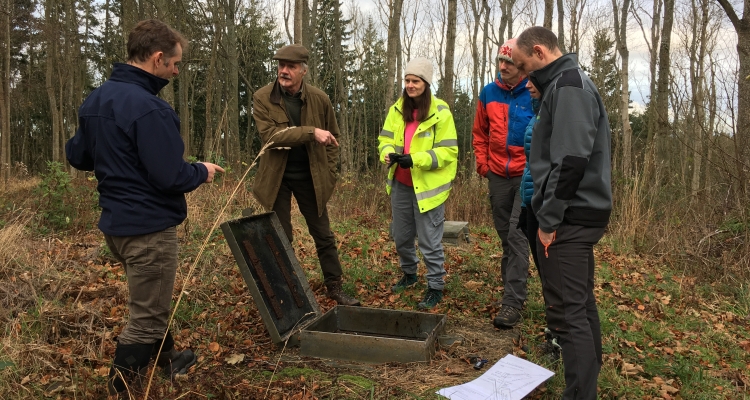
These two policy areas were explored when Scottish Land & Estates arranged for Scottish Government representatives working on policy development for water and wastewater to inspect, at the helpful invitation of their owners, the private water supply on Whittingehame Estate and the Private Sewerage Works at Fenton Barns.
Whittingehame Estate is not unusual in that its private supply, rising from the aquifer beneath the Lammermuir Hills, feeds numerous houses, only half of which are owned by the estate. The challenges were gripped head on in 2008 when, to simplify management of the infrastructure, they formed a company limited by guarantee.
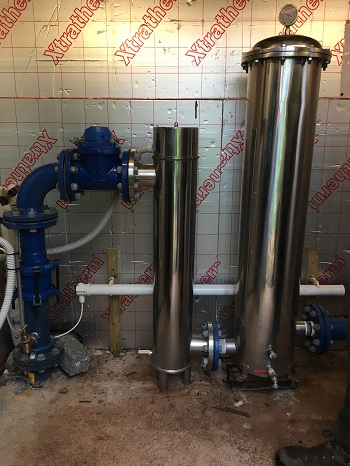
filtration and UV treatment system
Drawing reference to the extensive digital maps documenting the network, estate owner Micheal Brander explained to the Scottish Government team that the supply is lead free, with a combination of pipes in Victorian cast iron and modern alkathene, with a sediment and ultra-violet filter station (designed and installed by Highwater) upstream of the first houses on the system. The system is inspected annually by East Lothian Council and in their opinion is one of the best in the county – a fact that was wholeheartedly supported by the civil servants, who were clearly impressed. Craig Forster and Mike Ayres from Highwater also joined the visit and their technical expertise was particularly helpful.
One of the dominant pieces of policy work that the Scottish Government team is carrying out relates to increasingly likely seasonal water scarcity and undertaking work to encourage those that can to connect to the water main. The fact that Whittingehame Estate’s supply runs within a few yards of the water main to Stenton illustrated plainly many of the reasons why such a connection is not as straightforward as it seems. For example, it is not enough to simply connect to the main – because the whole network – the best part of 3 miles of pipework – would need to be adopted. Michael went on to explain how the considerable bureaucratic hurdles, invasive inspection requirements and associated expense make such a connection unattractive.
Regulations in respect of water quality are designed with no regard to the trials faced by the owners of even the most sophisticated and organised private water systems. These challenges vary in size and complexity and demand ongoing maintenance, compliance and associated expense. There is a grant available of up to £800 per property for improvements such as installing treatment, replacing lead pipes and putting in new water tanks but for some oddity it can’t be used for ongoing maintenance costs or indeed to connect to the mains water network – even though it is a government objective to get as many private supplies as possible onto the main where it is feasible.
The visit took the guests on to Fenton Barns where the focus moved away from the quality of supply into a system, to the quality of discharge out. One might assume that the environmental impact of pollution would be enough for government to design regulation so that enforcement can be taken against all polluters. Sadly, this is not the case and the anomaly surrounding regulation means that while SEPA is the authority responsible for regulating discharges to rivers, lochs, estuaries and coastal waters, it has no power to act against third parties polluting via a private plant – only against the owner of the plant, irrespective of whether the owners have the ability to take enforcement action against the polluter. It is important to remember that over time standards have changed, and regulation has long since transcended historical title deeds and contracts.
Fenton Barns has a legacy from the RAF which installed a sewerage treatment works in WW2 to support the airbase, dealing with waste from 4,000 personnel. This operates as a fully functional domestic trickle filter system which discharges under a CAR licence with SEPA. On inspection one would expect it to be owned by Scottish Water, such is the scale.
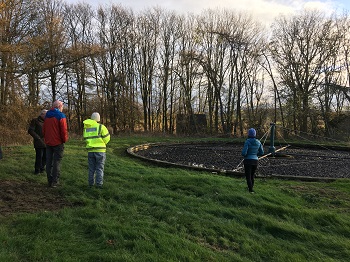
Nicola Simpson, who works closely with her father managing the estate, was able to explain that the successful operation of the works is marred by the absence of a legislative regime to assist private operators control the quality or quantity of incoming effluent. Although a rare example, it goes without saying that, for regulation to meet its purpose of protecting the environment, it needs to be drafted in a way that considers all scenarios and enables those who carry the responsibility for compliance to act when necessary. It was an eye-opening visit for the civil servants.
Water quality and environmental considerations are in the public interest and therefore better state support is needed for those who provide private water supplies or sewerage treatment in the absence of public services. However, financial support should not be a postcode lottery but take account of the complexities of individual system requirements, their locations, and the proximity of the mains services. Ultimately, like those who have never had to consider where their water comes from or how their sewage is treated, successive governments have taken for granted the impact and cost of such regulation for something provided by private landowners, rarely by choice, but as a necessity.
Comments