


Reflections on the launch of new report on Scotland’s Wellbeing Economy
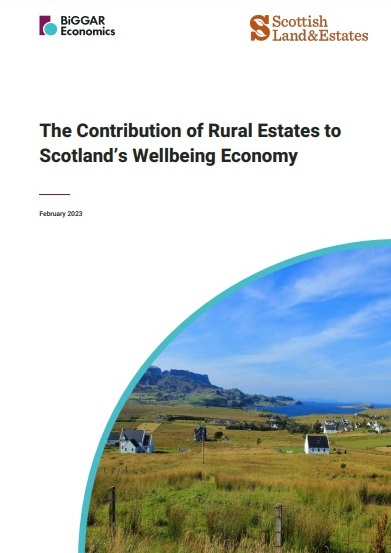 Our latest research, The Contribution of Rural Estates to Scotland's Wellbeing Economy, is now live following a successful launch event in Edinburgh on Tuesday 7 February. The landmark report was produced to quantify the sector's contributions to the wider wellbeing of the nation beyond just economics. The research was welcomed by the Minister for Public Finance, Planning and Community Wealth, Tom Arthur MSP, who also gave a welcome commitment to work with the sector and other stakeholders in navigating the issues facing rural Scotland.
The launch was well attended by SLE members, media, Conservative and SNP MSPs, Civil Servants, and stakeholders from other major organisations. The launch of the first-of-its-kind research was something of a turning point in how as a sector we understand what we offer rural and national Scotland, more so against the politically recognised metric of the National Outcomes. It has also offered us a fresh perspective on how we communicate these offerings and abilities to policy makers and the wider public.
The research, undertaken by BiGGAR Economics, demonstrates the land based business sector's contributions to seven of the eleven National Outcomes used by the Scottish Government to monitor progress in a number of areas which in turn foster a Wellbeing Economy.
Most significantly, estates are described in the report as Stewards of the Natural Environment, in that four out of five estates are actively engaged in conservation work, and account for around 57% of Scotland's renewable energy capacity. Although estates have long been well placed to manage land in the interests of the environment, these staggering figures firmly establish them as major delivery partners in helping to achieve the Scottish Governments' just transition to net zero.
The research also describes estates as Engines of Rural Growth - generating an estimated £2.4bn Gross Value Added (GVA) every year for the Scottish Economy and supporting around 56,310 jobs. Furthermore as Anchors for Thriving Communities, estates are also found to play an important role in sustaining populations in some of Scotland's more fragile rural communities, namely by providing homes and land for thousands of families and rural enterprises, with an appetite to increase this valuable contribution.
Desk-based research of the current policy landscape, various data sets, surveys, interviews and workshops with Scottish Land & Estates members formed the basis of the research. This produced a baseline of findings clearly quantifying the sector's contributions to Scotland's National Outcomes and the four National Capital stocks (human, natural, social, economic) that provide the foundations for a sustainable wellbeing economy. Estates were found to be major contributors to the Environment National Outcome, with Communities, Economy, Health, Poverty and Education not far behind.
So what next? The policy and public affairs team at SLE has the time and energy to devote to understanding initially abstract concepts such as the 'wellbeing economy', and it is our job to consider how an approach such as this can benefit the sector on our members' behalf. Ultimately, for the approach to take off, we need to help those landowners who are the putting in the work on the ground, to also understand the concept and what it means for their business in the short and long terms. Going forward, the wellbeing approach will feature more frequently throughout our communications to members and inform new and existing good practice resources, literature and training sessions.
Those who live and work in the sector largely understand the diversity and increasingly progressive nature of land based businesses and just how much work goes into delivering benefits for rural Scotland. Unfortunately, this is not well understood in wider public and political discourse. The fresh approach taken in investigating these wider societal benefits is intended to help with repositioning estates as the diverse, modern businesses they are. It will also demonstrate how much potential they have in driving future efforts to establishing a Wellbeing Economy in Scotland and helping tackle the nature and climate crises.
For this to be realised, policy makers must take the sector seriously as a delivery partner, foster a supportive policy environment to encourage this, and be committed to constructive dialogue and effective partnership working.
At Scottish Land & Estates, we are optimistic about this fresh approach and look forward to taking our members and policy makers on this journey as we look to increase the sector's offerings to the National Outcomes and rural Scotland.
The report, 'The Contribution of Scotland's rural estates to building a wellbeing economy,' is available to download from our website.
Comments