

Jamie and Sheri Blackett are the current owners of Arbigland Estate, Jamie being the sixth generation of his family to farm on the estate. Jamie is a retired army officer and an accomplished writer. He has written three books, The Enigma of Kingston (2017), Red Rag to Bull (2018) and Land of Milk and Honey (2022). Sheri is a photographer inspired by the landscapes and seascapes around Arbigland. Their children Oliver and Rosie occasionally live with their parents on the estate, Oliver is an entrepreneur and founder of John Paul Jones Rum and Rosie works in PR.
The dairy herd is about 650, with 400 young cattle. Bull calves are reared and sold into the food chain. The heifers are reared outdoors on the farm as soon as they can be weaned onto grass so that they can calve at 24 months. Dairy farming is regenerative for the farm's ecosystem and has high environmental and animal welfare standards. Regenerative farming at Arbigland includes grazing cows from February to December, grass is measured and grazed on a 3 week rotation, grass fed Jersey-Friesian cows, a multi-species ley, reduced fossil fuel use as cows walk to the milking tank, cowpats encourage invertebrates and birds, manure and trampling from cows create healthy topsoil, use of a covered slurry lagoon to reduce greenhouse gas emissions.
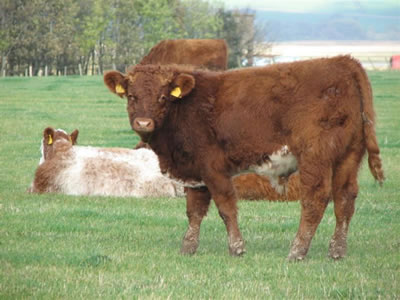
Arbigland Estate sold their entire pedigree Luing beef herd in response to Brexit in 2020, which was a difficult decision to make. They converted to dairy farming and started milking in January 2021, the Estate's practice of regenerative dairy farming. They have embraced the change to dairy farming and now produce 3 million litres of high butterfat milk a year for cheese-making.
In addition to regenerative farming, Arbigland Estate also practises conservation agriculture and has been involved in the Rural Priorities Environmental Scheme and its predecessor, the Rural Stewardship Scheme, since 2003. The upper headlands, beetle banks, unharvested crops, dense hedgerows, limited summer grazing and winter stubble all help to promote biodiversity on the estate. The estate has recently planted 3000 trees and 3500 metres of hedgerow to extend and enhance these existing habitats. These hedges are pruned every 3 years to keep them in fruit and provide valuable food and nesting cover for birds. These hedgerows also provide excellent wildlife corridors throughout the estate. The estate also has 70 acres of wetland habitat and 3 ponds where rare plant and bird species can thrive. All watercourses are fenced off from cattle, allowing reeds to grow along the banks, providing habitat for species such as the reed warbler. There are also over 20 bee hives on the estate; bees help to pollinate fruit trees and flowers, improving the overall biodiversity of the estate.