

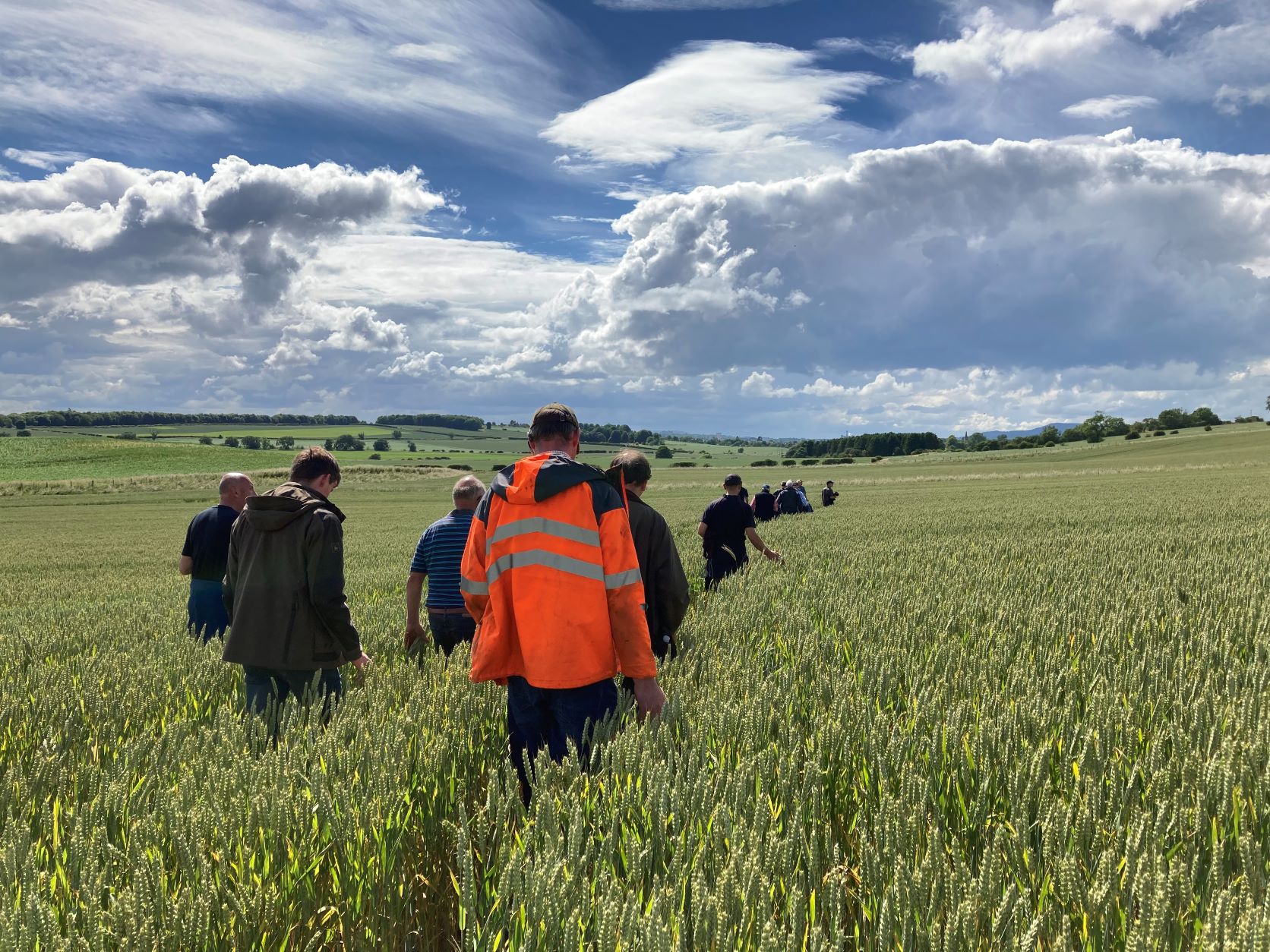
Balbirnie Home Farms has been working with AHDB for the past three years as its strategic cereal farm in Scotland, and an approach that prioritises plant and soil nutrition to reduce costs and reliance on chemical inputs has the potential to reduce variable costs across different crops by around £200 per hectare. The final case study in the RHASS Presidential Initiative's series on the science behind food production focuses on the regenerative farming approaches that Balbirnie Home Farms has been developing in recent years. These include cover cropping, direct seeding and reintroducing livestock into the rotation to improve soil biology and structure, and applying the essential micronutrient nitrogen through the leaves rather than the roots. The 1200ha Balbirnie Home Farms, which took its first step towards a more regenerative approach with direct drilling in 2015, grows mainly winter wheat and spring barley, as well as oats, winter barley, potatoes and carrots in a seven-year rotation. The 200-head suckler beef herd has been moved to an all-out grass system to improve soil health and is Pasture for Life certified. This has been one of the most tangible benefits, reducing nitrogen and fungicide requirements and costs, as well as winter feeding and housing.
With a growing interest in regenerative farming in the industry, AHDB initiated the six-year project to experiment beyond small research trial plots to see how different practices manifested on the scale and natural environment of real farm situations. Farms Manager David Aglen says they would not be able to afford the cost or time involved to do the trials, which also seek to identify the optimum drilling date, themselves and that the project, which is in year three of six, is accelerating them along a route they knew they wanted to go down: “Working with AHDB and SRUC like this helps us with measuring and using ‘proper’ science to validate what we are doing and make decisions. Some changes have worked really well, and we've had the occasional disaster - but hopefully others can learn from these without the cost and effort! By and large, we are seeing this as a cheaper way to farm. We may yield less, but it costs less, with our variable costs potentially down by an average across crops of £200/hectare. It has definitely changed our farm policy, and we now look at every decision through the regen lens.”
RHASS Presidents Initiative Vice President, Ewan Pate, says of the project: “Across the world, scientific evidence is showing the success of returning to a more biological approach to farming, but it’s not until we experiment in a local environment that we can see what works for farmers there in Scotland. This is the value of bringing together the scientific research and data analysis of AHDB and Scotland’s Rural College, SRUC, with the practical farming experience and context of Balbirnie Home Farms to inform the whole industry and produce good food.”