

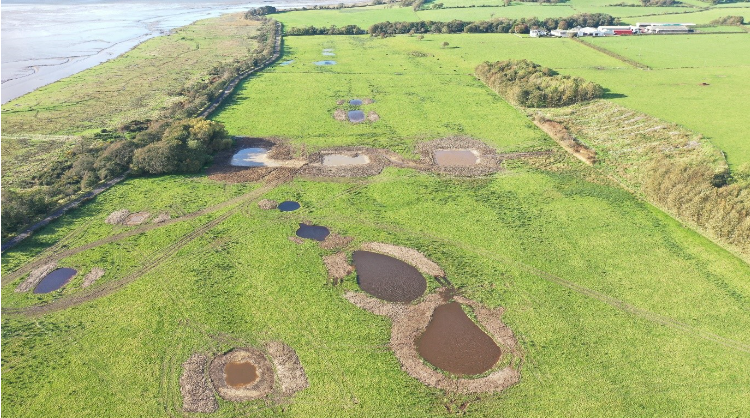
Caerlaverock Estate, located on the Solway Coast, has strong wildlife credentials, excellent agricultural land, and breath-taking scenery.
It is obvious that the successful and sustainable future of the estate lies in maximising the opportunity that each of these strengths represent for environmental gain, sustainable food production and nature-based tourism.
This, together with creating a thriving place for all of the estate’s current or future inhabitants - regardless of species, and is what current owner, Lady Clare Kerr, and Estate Manager, Anna Austin, are focused on.
Caerlaverock Estate is motivated by ensuring it continues to provide the habitats enjoyed by all its resident species in the face of environmental changes that may be faced by the estate as a result of climate change and rising sea levels.
The Estate has carefully selected areas of poorly performing agricultural land, which can be used to create a network 2 of ponds, with the help of finding through the Nature Restoration Fund.
Ponds which have been specifically designed to provide habitat to Natterjack Toads, waders and general wildlife and which are laid out in networks designed to help catch and filter water run-off from neighbouring fields, to slow the flow out into the Solway Firth.
Given the estate’s parallel motivations of efficient food production and a growing tourism offering, they are also mindful of ensuring wildlife can freely move around the estate.
To this end, several kilometres of berry rich wildlife corridor are being planted to link areas of habitat together.
Achieving balance is the key to success in a project like the one being carried out at Caerlaverock.
Ponds cannot be created without there being a perceived loss to the land available for agricultural use and alleviating concerns of employees, tenant farmers, neighbouring farmers, and wider members of the community in this regard has been something the estate has had to proactively manage.
Communication has been key and in taking time to explain the estate’s thinking at public forums and through informal chats, most now understand the estate has taken a measured approach in selecting areas of land for ponds which were difficult to keep dry and which did not generate large agricultural yields.
Most also understand that one of the true benefits of larger scale land management is that such decisions can be made for environmental benefit in a way that does not lead to disproportionate reduction in essential revenue.
It has also been important to explain the project is intended to exist alongside agriculture.
While Caerlaverock Estate is only mid-way through their nature restoration project, the biodiversity and environmental benefit of the work already complete is very clear to see.
Local ecologist and expert in Barnacle Geese, Larry Griffin, has been helping the Caerlaverock team measure success in this regard and while it is too early to conduct formal counting activity, he has said that it is clear that the ponds, the fields they are in and the wider landscape are already benefiting from the work done.
Two bird surveys carried out recorded at least 125 species, nearly all of which were likely to be utilising the new habitats created, chiefly for the insect and seed resource they are providing.
Larry’s view is that there will easily be 150 species to be found in the winter and this could grow to over 200 species in the next 5 – 10 years if carefully monitored.
It is believed that birds of conservation concern will already be benefitting from the project, and he noted that it was fascinating to see that the ponds had already been colonised by at least four or five species of Damselfly/Dragonfly, species of Starwort and Crowfoot and also by Common Frog and Toads.
The varied design of the pools is providing for ephemeral species as well as those requiring more permanent water bodies, which is key, and Larry highlighted that at the broader landscape scale, this will certainly be linking populations of plants, insects and birds.
In addition to the community engagement mentioned above, the estate has hosted several walk and talk sessions and meetings to inform the community about the nature restoration work being carried out, and how it will impact the wider estate activities.
The Solway Firth Partnership held a walk and talk focused on the project in December 2023 – Larry Griffin provided a talk during the walk of the benefit of our ponds from an ecology perspective.
We have a scout group visiting in August 2024 to learn about the project. The estate is in discussion with several educational establishments about learning and training opportunities that the project can offer.
These visits educate people on the importance of preparing future habitat for nature and provide an example of how farming can continue around such activity and of how sensitive tourism can take place in its vicinity.