

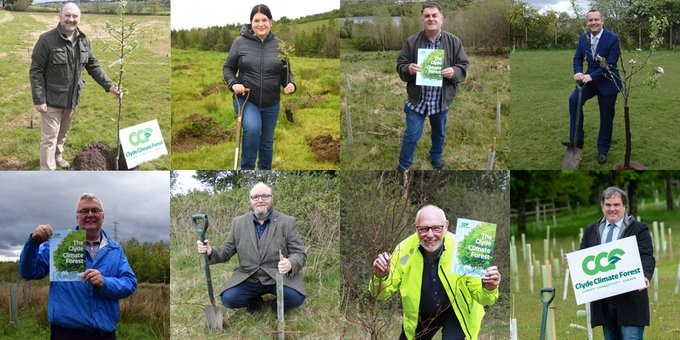
Clyde Climate Forest (CCF) is a ten-year project which channels current enthusiasm for tree planting into well-considered tree planting projects across the Glasgow City Region (GCR) for climate and other benefits. CCF is endorsed by the eight GCR Council Leaders and supported with funding from the Woodland Trust and Scottish Forestry. CCF aims to facilitate the planting of 18 million trees in urban and rural parts of region (10 trees/person in GCR). CCF is based on 3 'C's: Canopy- increase tree canopy in urban areas Connectivity- connect existing woodlands Carbon- expand woodland cover by 3% to lock-up carbon emissions.
The CCF team is comprised of three people. As a new operation we have no carbon footprint history and what carbon footprint we currently have is very small. However, our operating method strives to keep our footprint to a minimum by working from home, conducting meetings virtually and using public transport whenever possible. The greater aim of the CCF is to facilitate the reduction of other organisation's carbon footprint. The CCF is specifically established to provide a mechanism for communities, businesses and landowners (or land managers) to reduce their carbon footprints through woodland creation. We work with landowners to identify opportunities for them to address their residual carbon emissions through tree planting, or to generate carbon credits that can be traded to other organisations in the GCR who need to off-set residual emissions as part of a Net Zero plan for their business. The CCF is not only about mitigating climate change by reducing atmospheric carbon through tree planting. The CCF will also provide adaptation to the inevitable impacts of a changed climate through: - more urban trees which help to reduce the impacts of more intense 'cloudbursts' and heatwaves on people and infrastructure; - connecting up woodland habitats will provide more resilience for woodland species in the face of a changing climate by providing 'escape routes' to areas with more suitable climatic conditions (essentially a northerly migration) as the climate changes.