
Nominee Summary
Community Instrumental Music Service for Rural Scotland (CIMSRS) with Edinburgh Napier University is a service which goes around rural Scotland teaching adults music.
Overcoming Challenges
Adults in rural Scotland are often excluded from learning and making music due to their age and geographic barriers. School music education ceases at the age of eighteen, and rural communities typically have limited, if any, access to local music educators, meaning that people are forced to travel to pursue music, at great personal cost and effort. CIMSRS participants lamented their lack of access to music education, noting, for example: ‘I never had the chance’, I feel like we are just forgotten about’, and ‘I didn’t realise how isolated I was’. In response, ‘CIMSRS’ creates impact on communities and overcomes these challenges through the provision of accessible music tuition and enriching community music-making opportunities for adults in rural Scottish communities, providing significant life improvement for participants. Logistical and financial challenges include advertising for recruitment, sourcing of instruments, venues, and permanence. Instruments were borrowed from local instrumental music services, music libraries and music shops, free of charge. Some participants invested in their own, while others are borrowing long-term; no one is left without an instrument. Venues were acquired by selecting venues in the research areas that played a central role in their communities, funded by the Edinburgh Napier University Public Engagement Funding. Other challenges include creating an encouraging and motivating space, by adopting a humanizing pedagogy; a structured yet flexible approach led by individual's needs, respecting the demands of adulthood, the vulnerability of being an adult learner, by foregrounding compassion, and ensuring a positive, rewarding experience for all.
Supporting the community
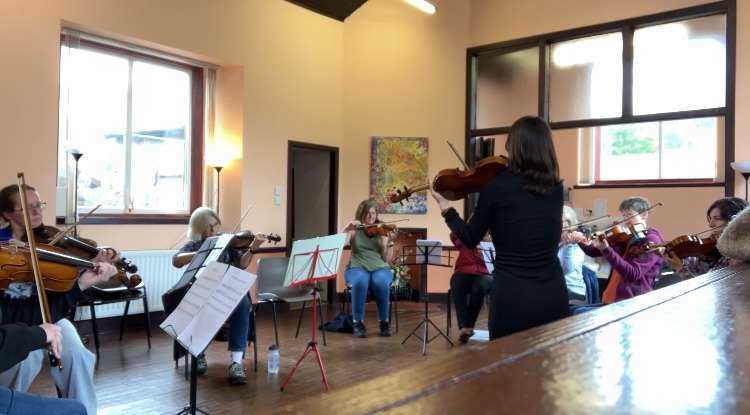
Despite the foundation of music education, CIMSRS’s impact is community-wide. So far, in three rural communities (Millport, Auchtermuchty and Glencoe) over 20 adults in each location, of all levels, receive regular, accessible, bespoke group tuition, followed by a jam session open to all. This provides opportunities to learn an instrument for the first time, a pathway for continuity for current players, and a space to make music with others in a supportive, local environment. The impact of this project has been enormous. Participants report feeling less socially and psychologically isolated, an increased sense of purpose (especially after bereavement, retirement, and childbirth), new friendships, anxiety relief, building self-confidence and skills, and even less usage of pain medication. As a result, participants have started their own music groups, such as Millport’s ‘Bothy Bowers’, and Auchtermuchty’s ‘Fife Fiddlers’. This project sparked social cohesion on various levels, from family life, where parents began learning alongside their children who receive music tuition in school, as well as bringing together others across the community in the jam sessions and community events, including concerts, Christmas light-up events, and collaborating with local theatre groups and choirs. CIMSRS widens the margin of beneficiaries of music tuition, strengthening the position for continued support of the local instrumental music service in schools, by building a pathway for continuity after young adults leave school for lifelong learning. CIMSRS uses local venues (supporting the local economy) contributing to self-sustaining music scenes building on the culture, traditions, and needs of the community
Ethical/environmental standards
Being an adult learner comes with many challenges, and it is important to recognize this vulnerability and the needs of each individual rural community and person for a successful project. The ethical basis for this project is centered around ‘humanness’. The pedagogy and structure of the project is to support the lives of adults and the challenges that come with adulthood, providing opportunities for engagement, not further barriers. Attendance is open, flexible, and materials are provided. All levels of playing are welcome, and a wide range of genres are performed for wider engagement. The teaching is bespoke and focuses on healthy playing for adults, with guidance on how to practice, group playing to foster a sense of agency and ownership in music-making from the first day. What makes this project unique is that it is regular, bespoke tuition that is relevant, student-led, and local to rural communities. Environmentally it reduces several dozens of cars on the road travelling to lessons and jam sessions, by having the teacher as the only traveler, reducing the carbon footprint from fuel emissions. The instruments are borrowed and reused, creating less waste and keeping products and materials in circulation. CIMSRS is a sustainable project, in community learning development, providing adults with the opportunity to engage with music learning and making, which brings overwhelming benefits to overall wellbeing and quality of life. The human-focused, community-driven approach, the environmental and local benefits have proven to be powerful in the enrichment of life in these rural communities.