

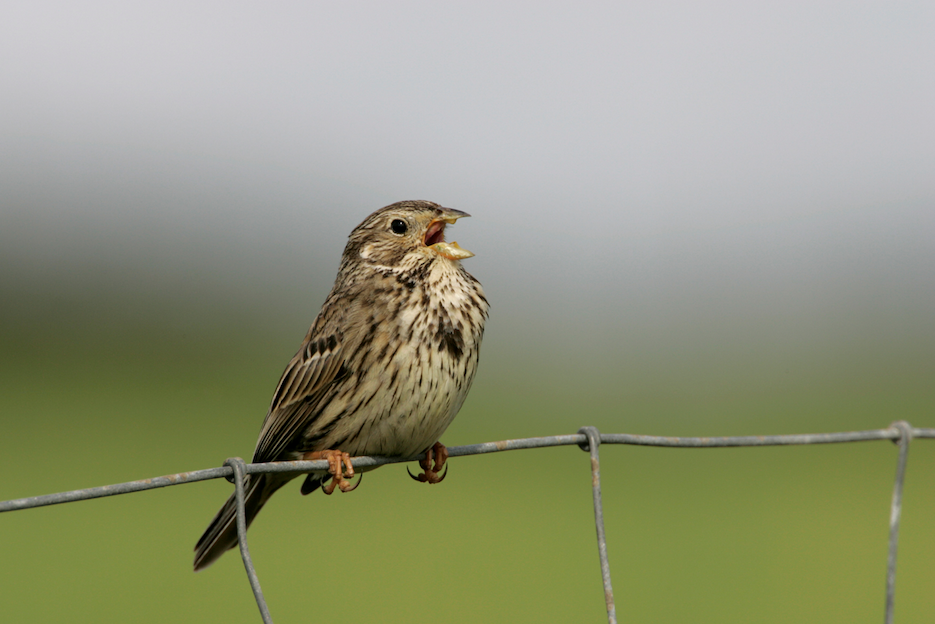
The Corn Bunting is one of the rarest birds in Scotland and one of its last strongholds is East Neuk where there is a remnant population of about 200. They can be heard singing from wires and prominent bushes around St Monans, Pittenweem and Anstruther and have a distinctive jangling song. A collaboration of farmers and other landowners in Fife has reversed the decline of Corn Bunting. The latest estimate puts Fife population of Corn Bunting at 372 territories, which is three times what it was at the lowest point in 2001. Numbers are up by 29% since 2020, following a 70% increase between 2014 and 2019. The entire eastern Scottish population had previously crashed by 83% between 1989 and 2007.
Corn Bunting's preference for nesting in growing crops later than most other birds and their reliance on large insects to feed their young, and cereal seeds to get through the winter, puts them at particular risk in a modern agricultural setting. The Corn Bunting Recovery Project has worked to provide safe nesting and foraging areas, as well as supplying winter food. For many years the RSPB has run a project encouraging farmers in the East Neuk to sow 5 acre patches of cereal plots as winter food for the corn bunting and this has enabled the population to cling on.
Yvonne Stephan, conservation advisor for the RSPB, said: "Even after so many years, it's amazing to see local farmers and landowners doing their best to help Corn Buntings. It’s heart-warming to see just how much effort has gone into bringing this little bird back from the brink, and how successful the management on participating farms has been." She added: "Assessing Corn Bunting numbers every year is a real joy as it reminds us of how many more chicks they have managed to raise successfully, and how many more adults are now making it through the winter."
More than 100 farmers were joined by the Links Trust and the Crail Golfing Society in their efforts to manage their land to benefit Corn Buntings. Local communities have also provided farmland bird feeders to provide winter food for the buntings, as well as Yellowhammers, Tree Sparrows and Eurasian Skylarks.
Find out more about the finalists for the Helping it Happen Awards 2023