

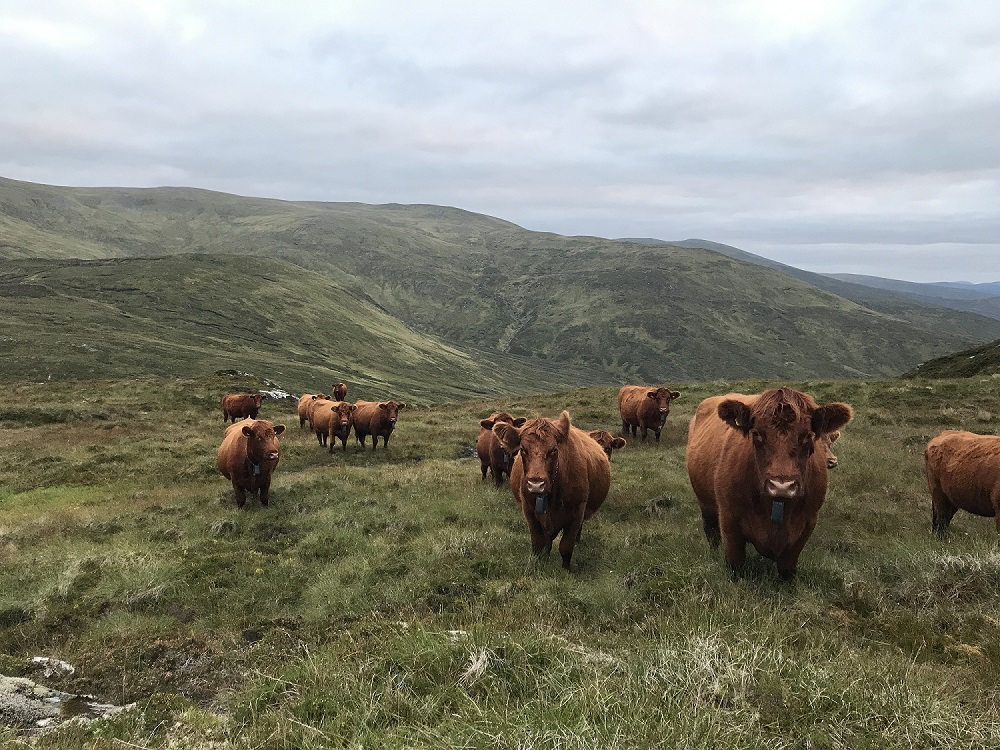
Andrew and Kate Duncan are pioneering in commercially adopting virtual fencing in Scotland, technology that has since seen wide interest. The couple established their herd as young farmers and new entrants and had to think differently in growing an eco-tourism business. The rugged terrain and remote landscape of Highland Perthshire presented the opportunity to return cattle to the hills for conservation and commercial benefit but with the challenge of no fencing infrastructure.
Andrew and Kate have set up and invested in a small farming enterprise that integrates with their growing eco-tourism business, which includes a newly renovated Bothy and Cottage available for holiday let, powered by a small hydro-electric scheme, with further accommodation projects underway. The easy option would have been to continue to let the small amount of inbye ground to neighbouring farmers. The ambitious couple however had other ideas and see the opportunity to combine the regeneration of the wild landscape, the ability to provide memorable experiences for holiday guests and the production of a sustainable product for customers to enjoy.
The growing herd of native Luing cattle are outwintered, calve outside and graze extensively on a variety of habitats including species rich pasture, fen meadow, heather hill and native woodland. The herd has achieved Elite Health Status and A Highland Life has begun to sell beef direct to guests and local customers.
Following online research for solutions from across the globe, Andrew made contact with Norwegian company Nofence, who at the time only had a handful of pilot projects in the UK. The Duncan’s were the first in Scotland to commercially utilise the NoFence technology and all their herd now wear a NoFence collar. The change in approach to managing their own herd, has allowed them to implement new technology, work towards a sustainable farming system and pursue a wider variety of environmental, social and economic outcomes.
With no cattle, the herd has been built up from an initial four cows. With cattle being publicly maligned for their role in global warming, the couple have been closely following the emerging science demonstrating that cattle grazed rotationally can be part of the solution, producing a sustainable and healthy source of food at the same time. The virtual fencing system has enabled this and allowed ground over 40min slow drive up a rough track to be grazed, with cows moving to summer grazing close to munro heights, roaming over large areas. The farm is now well equipped, the herd continues to grow and using the technology maximises benefits for the future.
The innovation has seen cattle return to the hills, allowing the grazed area to increase by 150 percent and the couple have been able to take on other rented ground where they have been able to show the benefits of the technology and target previously un-grazed areas due to the lack of fencing. A key advantage of the system has been the ability to rotationally graze allowing them to pursue a holistic planned grazing system that the couple continue to refine. Using the functionality of virtual fencing, to track where cattle have been grazing and in what density, Andrew is able to control the pasture boundaries to exclude sensitive habitats and manage grazing across others for nutritional, conservation, and environmental outcomes.
The couple have been happy to support NoFence with its development and to introduce the product to other farmers. Last year the couple hosted the first NoFence field day in Scotland with a subsequent webinar to which 180 farmers signed up. Andrew has hosted a number of other visits from interested farmers at all scales keen to understand the product and learn from his practical experience. Visitors now walking in the hills can scan a QR code to see where cattle are grazing at any moment in time. With the increased cost of fencing and concern around its landscape impact, the requirement for sustainable low carbon food production with the benefits of controlled grazing pressure in regenerating habitats mitigating climate change, the virtual fencing technology has an exciting future.