
Nominee Summary
Mycoforestry for carbon negative food production is a pioneering agroforestry system that can be integrated into existing food and forestry production landscapes to deliver nutritious protein rich mushroom crops from inoculated commercial forestry stands. By growing a range of mushroom species in association with trees, this system can sequester carbon, reduce agricultural inputs, boost biodiversity and soil health and improve income resilience in our increasingly unpredictable climate. Critically, our innovation deserves to win as it supports expansion of food and forestry production while reducing environmental impacts and without generating land use conflicts
The approach of your nominee
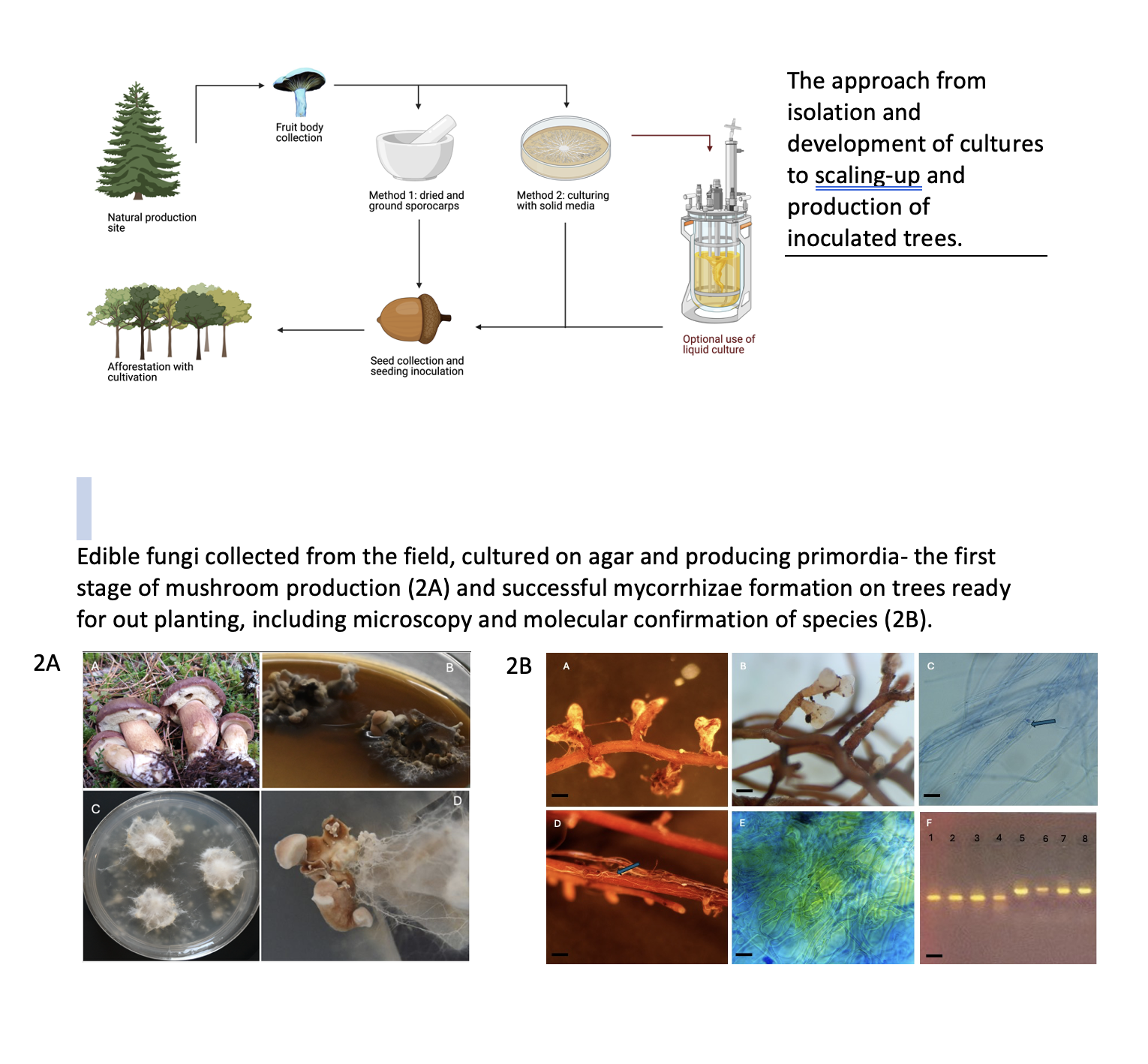
Prof. Alistair Jump and Prof. Paul Thomas have pioneered a genuinely groundbreaking farming innovation—mycoforestry. This new agroforestry model grows edible mushrooms alongside productive trees, creating a new class of food-producing woodland. It’s a low-input system that delivers high-value protein-rich crops while boosting biodiversity, restoring soils, and locking away carbon. Mycoforestry is designed to work with real-world farming and forestry systems without competing for land. Building on Paul’s 20+ years of research into truffle orchards with his company Mycorrhizal Systems Ltd, the team has shifted from gourmet delicacies to fungi that work across everyday landscapes. Since 2023, Paul’s research base on the Isle of Bute has added custom-built labs, growth chambers, and DNA sequencing equipment. With a dedicated research team, four edible species have now been successfully cultured and inoculated onto multiple tree types and earlier this year, the UK’s first edible mycoforestry trial site was planted in Northumberland. Alistair leads the ecological, economic, and climate modelling at the University of Stirling, that proves how this fits farming in Scotland and beyond. The mycoforestry systems capture significant amounts of CO₂e per hectare – contrasting with other food production systems which emit CO₂.
Overcoming Challenges
Producing edible mycorrhizal mushrooms on trees is novel but highly complex. Unlike standard mycorrhizal inoculants, these fungi are tough to isolate, finicky to culture, and reluctant to fruit. Through extensive research delivered through a highly effective university-industry partnership the team have overcome substantial methodological barriers to culturing wild mushrooms that require a tree 'host' to fruit. They team have developed protocols, proven colonisation with DNA tests, and are now unlocking the fruiting secrets using growth trials, climate modelling, microbial support species, and advanced R&D. This system also helps overcome economic barriers to tree planting. By producing food as well as timber, farmers get early returns that can make tree planting a viable business decision and better spread risk to income. The fungi improve drought resilience and reduce the need for synthetic fertilisers—cutting N₂O emissions along the way. With Alistair and Paul having worked together since 2017—and trial sites already planted, challenges in development have been overcome and we are ready to scale.
The impact of innovation
This innovation driven by Paul and Alistair expands opportunities for food production and commercial forestry at the same time without generating land use conflicts along the way. It delivers carbon-sequestering, soil-enhancing, food-producing trees that support biodiversity and bring revenue within a few years—not decades, thereby improving resilience of income streams under our increasingly uncertain climate. With potential for ~£11,000/ha/year in protein-rich fungi yield and carbon savings of ~6 tCO₂e/ha/year, this approach has real-world economic and environmental impact. Peer-reviewed research has confirmed its climate potential (Thomas & Jump, 2023, PNAS) and early trial results are already showing a host of benefits, built on the successful development and deployment of the inoculation techniques first developed by the company for commercial truffle production. Outputs include improved planting stock, microbial inoculants, and free grower guides. With planned field demos, media coverage, and public events, they’re making sure this innovation delivers expanded opportunity for farming—rooted in research, grown through collaboration, and ready to reshape how we use land in Scotland and beyond.