Nominee Summary
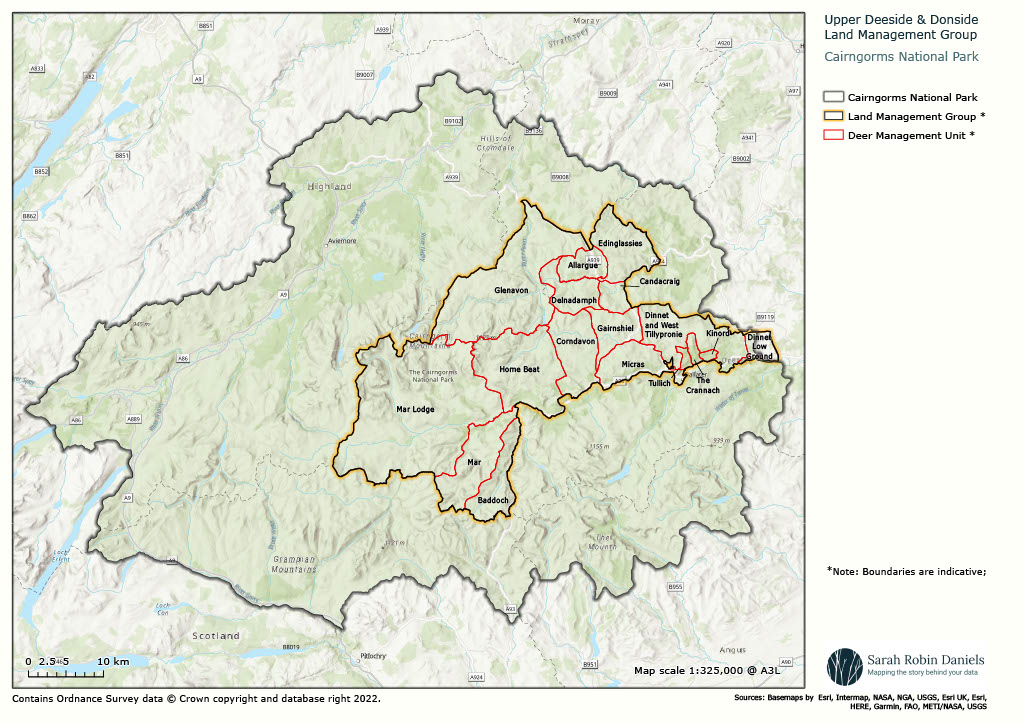
Upper Deeside and Donside Land Management Group comprises seventeen land managers in the private, charitable and public sectors who work constructively together to manage common land based interests in an area covering around 101,592 ha, a quarter of the Cairngorms National Park. As well as delivering collaborative action on sustainable deer management, the Group acts as a conduit for wider information sharing and gathering, thereby taking a new approach to working together in the land management sector in Scotland.
What was the motivation behind the work which was undertaken?
Originally formed in 1996 as a Deer Management Group, the group has evolved to reflect the diverse and complex mosaic of land use objectives and land management activities of its increasing membership. With focus on the appropriate management of Scotland’s natural capital assets, such as soil, water quality and carbon-sequestering habitats, the successful achievement of these nature-based targets is wholly dependent on the continued voluntary cooperation, support and contribution from landowners and the rural land management sector. The main motivation behind the Group is to promote collaboration at landscape scale which supports the wider environmentally, economically, and socially sustainable management of land, flora and fauna within its area, achieving both private and public benefits, and where this is better enabled by co-operation between land management units. In so doing, the has sought to exemplify how working together delivers better results.
Overcoming Challenges
The Upper Deeside and Donside Land Management Group has now become the first constituted deer management group to sign up to the Common Ground Accord. However, long before the excellent work of the Common Ground Forum, in the early days the Group faced considerably challenges in resolving conflict over significant deer reductions being undertaken by one of its members. At the time the proposals were highly controversial and emotive. However, through working together in the true spirit of collaboration, the Group was able to resolve the issues. As such is an exemplar model of collaboration and integration of diverse land management objectives where ecological restoration sits alongside the sustainable management of deer and moorland management for grouse, deer stalking and other purposes. Mark Nicolson of Group member Mar Estate explained “In the experience of our Group, the discussion often underplays the ability of people to work together. In the Upper Deeside and Donside area we have wide range of objectives both between and within estate members. The Group provides a place to understand deer populations and movements, identify conflicts and resolve them. These principles are exactly what the Common Ground Accord is about, exemplifying how collaboration can work.”
Including the community
Community engagement has been central to the work of the UDD LMG. This has taken the form of publishing minutes and other information on the Group’s website, representation at local community council meetings, consultation with communities for its current deer management plan and issuing press releases on the work of the Group and its local successes. Information about the Group has also been shared with local community groups on social media.