

Guest blog from Highlands Rewilding: Reintroducing Wood Ants
When species reintroductions are mentioned in the context of a rewilding project, thoughts tend to turn to wolves or lynx. However, we have reintroduced a much smaller species back into our pine woodland, but one which plays a disproportionally big role in the ecosystem: the wood ant.
In Scotland, there are two ‘true’ wood ant species; the Scottish wood ant Formica aquilonia and the hairy wood ant Formica lugubris. Their ranges overlap but the Scottish wood ant is less common and found in older, closed canopy woodland, while the hairy wood ant is often found along woodland edges or clearings. Both are important ecosystem engineers as they disperse seeds, cycle nutrients, impact other invertebrate populations and also provide a source of food for other species. They have a particular and fascinating relationship with aphids, who feed on tree sap in the forest canopy. Aphids excrete excess sugars as ‘honeydew’ and this forms up to 90% of the wood ants’ diet. The ants ‘milk’ the aphids, often protecting them from predators, and carry the honeydew back to their nests, which also transfers carbon down into the forest soils. In fact, the role of wood ants within forest ecosystems is so important that they’re considered keystone species and we were keen for our woodlands to again be more complete under their influence.
Wood ants are easily recognisable by the large mound nests they create on the forest floor – and their absence is noticeable in Bunloit’s pine woods. The reasons for this absence are not known but could be related to historic losses in woodland cover. Further west in Glenurquhart, there is a good population of hairy wood ants and Forestry & Land Scotland were happy for us to translocate four nests from this area to Bunloit.

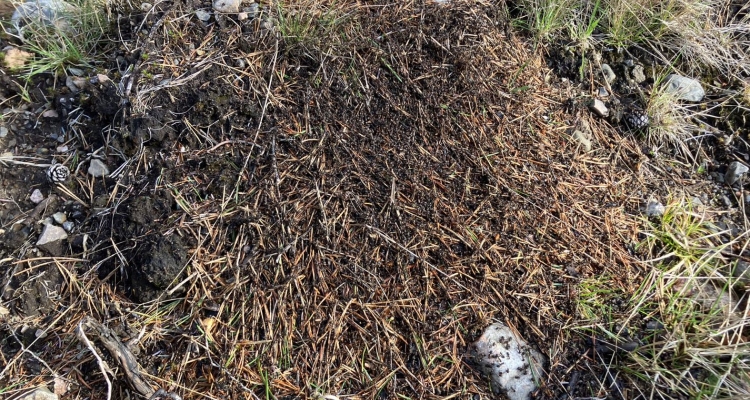
Hairy wood ant nest, prior to translocation. Note the crowd of ants
clustering on the surface to catch the early morning warmth.
Wood ants start to become active after the winter in the first warm days of spring and they can be seen crowding on the surface of the nest, catching the early rays of sunshine. This is the best time to translocate a colony, as most members are clustered together and not yet spread out into the woodland. The queen ant will likely be there too, before she descends to the heart of the nest to spend the next weeks laying eggs. So one sunny early morning in April, armed with spades and barrels, we selected the nests to move, dug them into the barrels (taking care not to inhale too much formic acid! – wood ants defend themselves by spraying this acid from their behinds) and brought them back to their new home at Bunloit.

Digging the nests into the barrels for transport.
We had already identified the sites to place them, choosing the base of a birch or pine tree, with a south-east aspect and only partial canopy cover. The ants survived the move and were immediately busy, presumably sorting out the chaos that their nests had become. We are keeping a close eye on the nests, as well as monitoring the surrounding insect communities – it will be really interesting to see how the ants impact the latter and we wish them all the very best in their new home.

Carrying the nests to their new homes on Bunloit.

The views expressed in this blog are those of Highlands Rewilding and do not necessarily reflect the views of Scottish Land & Estates. No liability can be accepted by Scottish Land & Estates or any of its staff for any misstatement in it or omission from it.
Comments