

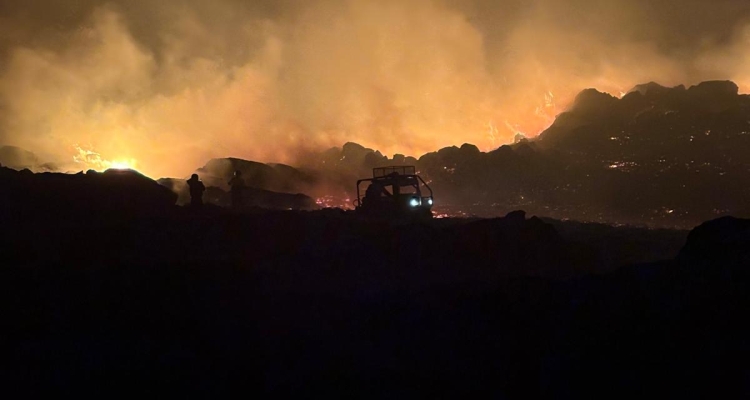
New report praises estates, farms and rural businesses for heroic role in tackling Scotland’s largest ever wildfires
Press ReleaseScottish Land & Estates (SLE) has today published a major new report detailing the exceptional response by land-based and rural businesses to the devastating wildfires near Carrbridge and Dava, which burned across an unprecedented 11,827 hectares of moorland and woodland in late June.
The release of the report coincides with a visit to the affected area by Jim Fairlie MSP, the Minister for Agriculture and Connectivity, who met with local land managers and stakeholders involved in the emergency response.
Prepared at the request of Scottish Government officials, the report reveals the extensive resources, manpower and expertise contributed by at least 33 businesses, including 27 estates. The collective value of specialist firefighting equipment deployed by private land managers is conservatively estimated at £3.1 million, with over 100 employees engaged in the containment effort.
Ross Ewing, Director of Moorland at SLE, said:
“The Carrbridge and Dava wildfires represent the largest such event in Scotland’s history – and without the extraordinary intervention of rural businesses, the scale of devastation would have been even greater.
“These land managers brought not only equipment and personnel, but also essential knowledge of the terrain and fire behaviour – much of it honed through generations of safe muirburn practice. Their contribution should be commended, supported and learned from.”
Among the findings:
More than 110 ATVs, fogging units, tractors, diggers, water bowsers and other assets were deployed.
At least 101 employees from the businesses surveyed were engaged in the containment effort. 79% of those who helped had practical experience of controlled burning (muirburn), with 66% formally trained in its use.
A wide range of advanced tactics were used, including tactical backburning, coordinated ATV chains, firebreak excavation and suppression using fogging units, leafblowers and slurry tankers.
Several near-miss incidents occurred, underscoring the volatility of the fire and the bravery of those responding.
The report also highlights key gaps in the Scottish Fire and Rescue Service’s (SFRS) wildfire response capability, and makes a series of recommendations, including:
Investment in a fleet of at least 50 SFRS all-terrain vehicles equipped with fogging units
Enhanced authority for SFRS commanders to deploy aerial support quickly
Urgent improvements in wildfire training and communications for frontline crews
Establishment of a Scotland-wide Integrated Fire Management Strategy
The report also highlights that the licensing framework for muirburn, as introduced through the Wildlife Management and Muirburn Act 2024, could reduce the ability of land managers to conduct fuel load management – a key factor in wildfire prevention.
Ross Ewing continued: “If we make it harder for skilled land managers to carry out preventative muirburn, we risk losing the very infrastructure and capability that helped contain these fires. Under the recent legislation, there is a ‘necessity’ test regarding use of muirburn on peatland, and a presumption in favour of other vegetation control methods.
“By amending this to an appropriateness test, it would allow this vital practice of muirburn to be carried out more freely while simultaneously retaining licensed regulatory oversight by government agencies.”
In addition, the report calls for government exploration of a compensation mechanism to support businesses that suffered financial losses – including damage to equipment, infrastructure and peatland restoration projects – as a direct result of their firefighting efforts.
Mr Ewing concluded: “The Scottish Government must treat these wildfires as a watershed moment. That means urgent investment in firefighting infrastructure, better coordination between public agencies and rural communities, and a policy environment that empowers land managers – rather than penalising them – for playing their part.
“Without the courage and commitment of those who stepped up during this crisis, the outcome would have been far worse. We owe them our thanks – and we owe them action.”
A copy of the report is available to download here.