

Evidence-based postponement of muirburn licensing following record wildfires welcomed by Scottish Land & Estates
Press ReleaseA pragmatic and evidence-based decision to postpone the implementation of muirburn licensing has been welcomed by Scottish Land & Estates.
The rural business organisation commented after the Scottish Government announced that it was suspending the start date of the scheme until the start of the next muirburn season in autumn 2026.
The Scottish Government said that the delay will “provide us with the time and opportunity to carefully consider the upcoming changes to muirburn and how these changes can be brought forward in a way which does not adversely affect our ability to prevent and respond to wildfires.”
Muirburn licensing – introduced under the Wildlife Management and Muirburn (Scotland) Act – had originally been due to take effect at the start of the 2025 muirburn season on September 15.
However, following recognition of the significant logistical challenges involved, particularly around the measurement of deep peat, the implementation was pushed back to January 1, 2026.
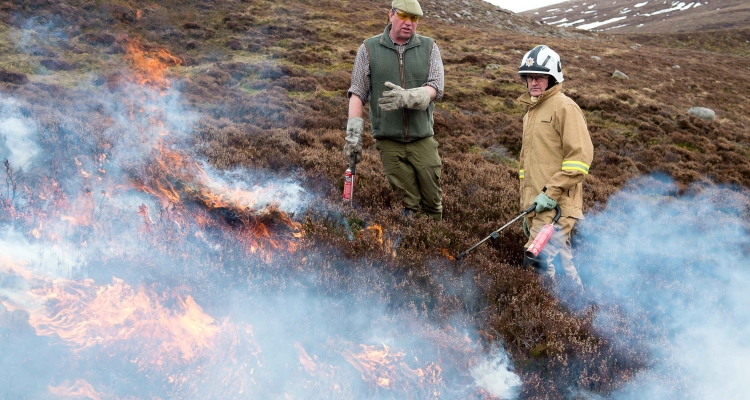
Now, in the aftermath of the devastating Carrbridge and Dava wildfires – Scotland’s largest ever wildfire, which is estimated to have released 590,000 tons of CO2 equivalent over just four days – the Scottish Government Minister for Agriculture and Connectivity, Jim Fairlie MSP, has opted to delay the scheme further. The move acknowledges the crucial role that controlled muirburn plays in reducing fuel load to mitigate risk and support containment efforts by land managers and firefighters.
The announcement also comes ahead of next week’s ‘wildfire summit’ to be led by Jim Fairlie and Siobhan Brown (Minister for Community Safety), in Grantown-on-Spey.
Ross Ewing, Director of Moorland at Scottish Land & Estates, said:
“Muirburn, as carried out by estates, gamekeepers and land managers across Scotland, remains an essential tool in mitigating the growing threat of wildfires. Its importance to effective upland and moorland management cannot be overstated, and we welcome Jim Fairlie’s decision to listen to stakeholders and pause the introduction of licensing.
“Without this delay, the ability to undertake controlled muirburn would have been significantly constrained, increasing the build-up of vegetation and, in turn, the risk of wildfire.
“As we revealed in our report to the Scottish Government, extensive resources, manpower and expertise was contributed by at least 36 businesses, including 30 estates, in fighting the Carrbridge and Dava wildfires. The collective value of specialist firefighting equipment deployed by private land managers is conservatively estimated at nearly £4 million, with at least 110 employees and contractors engaged in the containment effort.
“If we make it harder for skilled land managers to carry out preventative muirburn, not only will we see fuel loads increase, but we also risk losing the very infrastructure and expertise that helped contain these recent fires. That would be catastrophic for rural Scotland.
“The Wildlife Management and Muirburn Act sets a stringent ‘necessity’ test for muirburn licences to be granted on peatland, with a presumption in favour of alternative vegetation control methods. Repealing these provisions would provide a more practical framework, ensuring muirburn can be used where it is the most effective management tool, while retaining full regulatory oversight through the licensing system.
“We look forward to continuing constructive dialogue with the Scottish Government in the months ahead, particularly at next week’s wildfire summit, and we welcome the government’s recognition of the importance of evidence-based decision-making on muirburn.”
Scottish Land & Estates’ report on the Carrbridge and Dava wildfires, prepared at the request of Scottish Government officials, also led to several key recommendations on tackling wildfires from SLE, including:
- Investment in a bespoke SFRS aerial capability and enhanced authority for SFRS commanders to mobilise private helicopter assets. [Helicopters were deployed for 96 hours during Carrbridge-Dava at a cost of c. £240,000].
- Investment in bespoke SFRS ATVs with suppression and containment capabilities.
- Creation of a Scotland-wide Integrated Fire Management Strategy (IFMS) as an urgent priority, with leadership and input from the Scottish Government.