

New polling reveals healthcare, infrastructure and employment are top of mind for rural Scotland
Press ReleaseNew research commissioned by rural business organisation Scottish Land & Estates (SLE) has revealed that the Scottish public see access to healthcare, improving infrastructure and supporting employment opportunities as the top priorities for rural Scotland.
The independent poll, conducted by the Diffley Partnership in April 2025, surveyed more than 1,200 people from both urban and rural communities to gauge public attitudes towards rural policy.
The findings raise questions about the Scottish Government’s focus on land reform - which was ranked as the least important policy area by respondents.
When asked which policies should be prioritised for rural Scotland over the next five years, respondents identified the following top concerns:
48% said improving access to healthcare should be a priority
43% prioritised the need for better infrastructure, including roads, transport and broadband
41% called for more focus on creating long-term employment opportunities
36% supported the development of affordable housing to sustain rural communities
In contrast, land reform was ranked lowest of all, with only 6% of respondents considering it a priority.
When considering priorities at a national level, 98% viewed the NHS and healthcare as an important issue, with economic growth (93%) and education (92%) also ranking highly in terms of importance.
Sarah-Jane Laing, chief executive of Scottish Land & Estates, said:
“This research confirms what we’ve heard time and again from rural communities - people care deeply about jobs, homes, education and health services.
“It’s clear that a disproportionate amount of time is spent debating policies that the public doesn’t see as relevant to their lives. When people are asked about what matters for rural areas, they talk about GPs, schools, housing, broadband and roads. They want support for the rural businesses already delivering across these areas, not more costly bureaucracy that risks holding back progress.”
The findings with regards to land reform mirror previous Scottish Government research, conducted by Ipsos MORI Scotland in conjunction with SRUC, which found that 73% of respondents said they knew 'not very much' or 'nothing at all' about the government’s land reform agenda. In the same survey, only 17% of respondents suggested inequality in land ownership is the biggest challenge for the future of Scotland’s land.
In this new Diffley Partnership survey, 67% of respondents said they were not familiar with the current distribution of land ownership in Scotland.
Cameron Gillies, Head of External Affairs at SLE, said: “The new findings confirm what the Scottish Government’s own polling has said - land reform isn’t on people’s radar until they’re told it should be.
“Rural businesses are doing the things people care about: managing land for food, nature and renewables, building homes, creating jobs. It’s time for government and politicians to get behind them and we hope this poll can act as a call to action for our elected representatives to work with us to deliver for rural Scotland.”
The new poll also highlighted the public’s expectations for how land should be utilised – land uses that rural estates are already delivering on. It found:
64% support managing land for wildlife and nature
56% support food production
37% support renewable energy projects
34% want land used for affordable housing
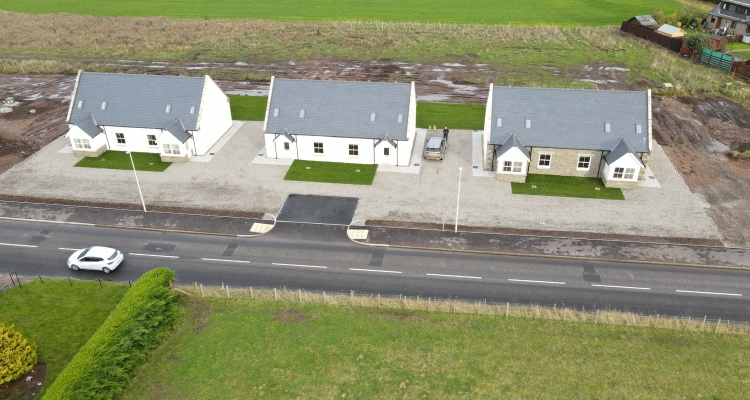
A prime example is Stracathro Estates in Angus, which recently built several affordable homes specifically to support young local working families. The homes are let at around 40% below market rent, helping to secure the future of the local school.
While their positive impact is substantial, rural businesses like Stracathro are frequently caught up in broader political discussions about land reform.
Hugh Campbell Adamson of Stracathro Estates said: “At a national level, estates are often portrayed as part of the problem - but on the ground, we’re delivering real, tangible benefits.
“We built these homes because we could see our community was shrinking. Now, not only are local families able to stay in the area, but the threat of school closure has been lifted. That’s the kind of legacy we want to create, and it's exactly the kind of outcome the government says it wants too.”
SLE added that these results demonstrate the need for a supportive policy environment that empowers land managers and rural businesses to continue delivering across economic, environmental and community priorities.
Sarah-Jane Laing concluded: “Landowners and rural businesses are walking shoulder-to-shoulder with the public. We're not asking for special treatment - we're asking for the government to back those already delivering what the country says it wants.
“Scotland’s rural economy has the potential to be a national powerhouse on everything from net zero to food security to housing but to get there, we need greater focus on the everyday priorities of the rural population.
“If government wants to be in step with the people - and not just with political activism - it’s time to reset the agenda and take steps to enable rural Scotland to thrive.”
Rural Scotland's Priorities - Public Attitudes Survey on Rural Policy (PDF, 5.7Mb)