

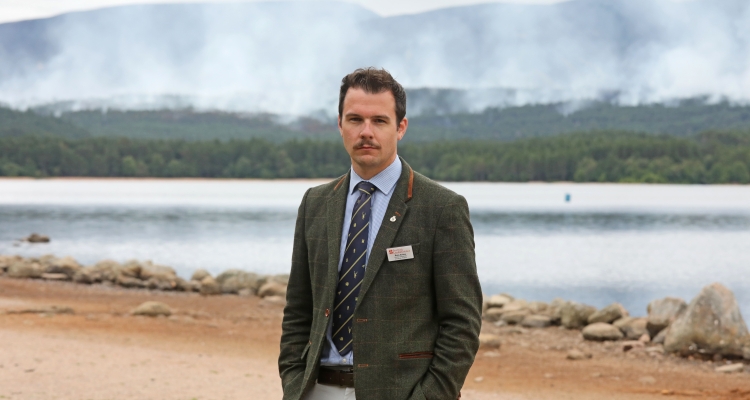
New report reveals scale of Glenmore-Strathnethy wildfire response
Press ReleaseScotland’s wildfire response cannot run on goodwill alone, rural businesses warn
A new report has found more than 3,300 hectares were burned in the Glenmore-Strathnethy wildfire – with more than 40 businesses and organisations and £6.4 million of private-sector equipment involved in the response efforts.
Published by Scottish Land & Estates, the rural business organisation, the new report for the Scottish Government has found more than 300 days of volunteering work were recorded (comprising 266 person-days and 38 person-nights).
In releasing the new report, SLE has warned that Scotland is being left dangerously exposed to major wildfires because the country still relies too heavily on informal goodwill, improvised mobilisation, uncertain helicopter availability and a policy approach to muirburn that could undermine the very rural capability needed in an emergency.
This week, the Scottish Parliament is due to consider the growing risk of wildfires in Scotland on 1 September, followed by a ministerial statement on the Glenmore-Strathnethy wildfire on 3 September.
Among the key findings of the report are:
More than 3,300 hectares burned during the Glenmore-Strathnethy wildfire.
More than 40 businesses and organisations were contacted, volunteered assistance, were authorised to assist or were placed on standby.
More than 250 recorded pieces of specialist equipment were available, including Argocats, ATVs, fogging units, bulldozers, excavators, tractors, water tanks, bowsers, pumps, radios, PPE and hand tools.
The combined stated value of recorded equipment was nearly £6.4 million.
Survey returns recorded 266 person-days and 38 person-nights volunteered, authorised to assist or placed on standby.
The report highlights the need for improvements in mobilisation, tasking process, communications, PPE provision and welfare.
The report calls for a dedicated helicopter and pilot services framework for wildfire response, with guaranteed availability, mobilisation standards, activation thresholds, mapped water sources, refuelling and landing options, trained liaison roles and ground-to-air communications.
The report warns that unworkable muirburn licensing could have serious second-order consequences by reducing investment in the trained people, fogging units, all-terrain vehicles, leafblowers, water-moving equipment and fire-behaviour knowledge that currently support Scotland’s rural wildfire response.
Ross Ewing, Director of Moorland & Strategic Projects at Scottish Land & Estates and author of the report, said: “The Glenmore-Strathnethy fire showed rural Scotland at its best – people, machinery, local knowledge and specialist expertise made available at speed. But it also exposed a dangerous weakness in that Scotland is still relying on goodwill and improvisation when it needs a planned, exercised wildfire resilience system.
“Estates, contractors and conservation bodies are willing to play their part in future – but this must come as part of a properly planned process rather than a last-minute call as a wildfire begins to rage.
“Following the Carrbridge-Dava response, we have firmly established these organisations as an essential part of the national wildfire response, and their role must be identified before the next period of very high or extreme risk. That requires a system to be built to identify who has the machinery, water-moving capacity, local knowledge and helicopter access.
“We need guaranteed aerial support when risk is highest, as well as a licensing regime for muirburn that does not erode the skills and equipment Scotland depends on when wildfire breaks out. After two major wildfires in the space of just over a year, we know that the next major wildfire will not wait for us to be slow on this matter.”
Key recommendations from the report include:
Call to Scottish Ministers
SLE is calling for an urgent shift from ad hoc assistance to a formal, exercised wildfire capability system. With MSPs set to debate the growing risk of wildfires in Scotland on 1 September and ministers due to make a statement on the Glenmore-Strathnethy wildfire on 3 September, SLE said the report provides practical recommendations that should inform immediate parliamentary and government action. The report recommends a live wildfire capability register through the Community Asset Register, a standard mobilisation and tasking process, local wildfire groups in high-risk areas, integration of estate fire plans into wider wildfire management plans, a reimbursement and repair mechanism for private machinery, and a joint exercise programme involving land managers, SFRS and public agencies before the next high-risk season.
On helicopters, the report calls for a dedicated wildfire aviation framework rather than ad hoc reliance on private contractor availability. That framework should guarantee access to suitable helicopter assets during periods of very high and extreme wildfire risk, with minimum availability requirements, mobilisation times, activation thresholds, funding routes, mapped water sources, refuelling and landing options, trained liaison roles, ground-to-air communications and clear procedures for linking aircraft with ground crews, heavy plant, firebreak construction, tactical backburning and hotspot suppression.
On muirburn, the report warns that regulation must strengthen, not hollow out, Scotland’s wildfire resilience. Much of the estate-based equipment and experience recorded in the response exists because land managers undertake planned muirburn. If licensing arrangements make lawful muirburn impractical, uncertain or commercially unjustifiable, Scotland risks losing a ready-made wildfire response reserve – including trained operators, specialist vehicles, suppression equipment, water-moving capability and practical fire-behaviour knowledge. The Scottish Government should therefore treat workable muirburn regulation as part of Scotland’s wildfire resilience architecture, not as a separate land-management issue.
A copy of the report is available to download here.