

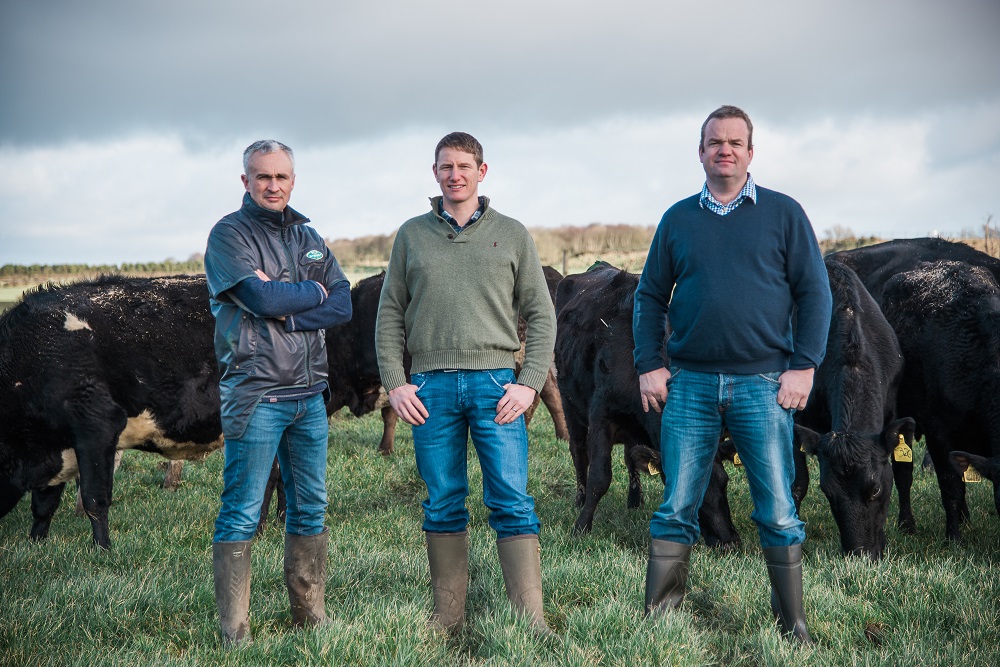
Fastbreeders is a collaborative project involving four pasture dairy farms. It uses data to enable precise genomic selection decisions to maximise the health and efficiency of crossbred dairy cows. Data has been collected from approximately 7,000 animals over several generations and includes records on fertility, liveweight, milk output and quality and wider health traits. This is matched against genomic samples and used to develop a highly accurate culling and selection tool and an evidence base to choose breeding sires. The aim is to accelerate health and productivity gains towards a net zero cow bred for the environment of South West Scotland.
By collaborating the four farms (milking 4,500 mainly Jersey cross Holstein dairy cows) enabled access to greater genetic diversity providing more opportunity to accelerate gain. Additionally, as a team we are better able to deal with the technical challenges, it is fantastic to be able to discuss and share how these can be resolved. By offering ourselves as a group we have been able to attract partners like Prof Mike Coffee from SRUC and Hamish Walls from SAOS who both help us deliver the project. Finally, day to day, farming can sometimes be a lonely business and its great fun working with other similarly minded farmers, the banter is excellent!
Looking at the environmental, social and economic benefits of this innovation, climate change and rapidly rising costs have emphasised our need to change our farming systems to make them more resilient and to target net zero production. Our low input pasture system aims to make more from less, i.e. great dairy from sun, rain and soil – ‘solar powered milk’. Second, as a group of four collaborating farmers we gain a huge amount from our social interaction, its great fun and together we learn more at a faster pace. We also spread our learning to other farmers using similar systems so they too can benefit from our knowledge. Finally, being more sustainable is good for business.
Using AI with superior bulls only allows us to obtain gains on the male breeding pathway which nationally averages out at 1.1%/year. Opening the female side will enable us to significantly raise this benchmark and become more profitable and sustainable on almost every measure. We are confident this can happen but cautious about quantifying any gains until our project is further developed.
The project will fundamentally change the way dairy cow reproduction is delivered and will consolidate the farms into an information nucleus that can be developed for a whole range of other management practices. This alongside retaining our ownership of the process will be incredibly important going forward.