

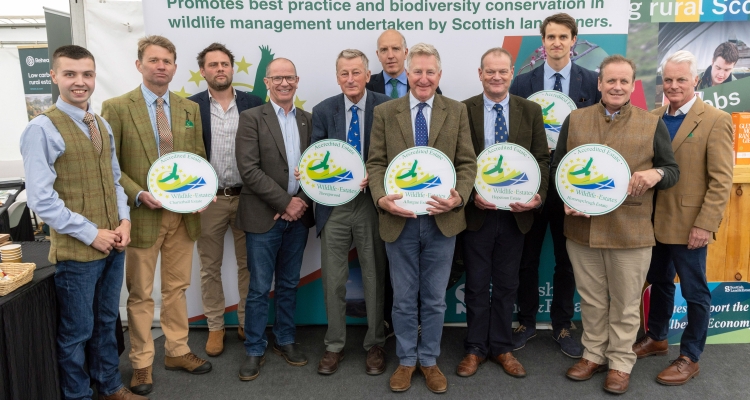
Six Scottish landholdings celebrate Wildlife Estates Scotland accreditation
General NewsSix Scottish farms and estates – accounting for over 23,000 acres - have been awarded prestigious international accreditation to recognise their ongoing work in wildlife management and conservation.
The award of Wildlife Estates Scotland (WES) accreditation was made at the GWCT Scottish Game Fair by Scottish Government Minister for Agriculture and Connectivity, Jim Fairlie MSP.
The accreditations were awarded to:
Stracathro Estate, Angus
Hopetoun Estate, Lothian
Charterhall Estate, Berwickshire
Horseupcleugh Estate, Scottish Borders
Allargue Estate, Upper Donside
Threepwood, Scottish Borders
(More information about each of the landholdings is noted below.)
WES is a national version of the Wildlife Estates (WE) initiative and is endorsed by the European Commission’s Directorate-General Environment, whose objective is to protect, preserve and improve the environment for present and future generations.
Any size and type of landholding, farm or estates can apply for accreditation which lasts for up to five years before a reaccreditation process must be completed. Scotland currently sits second in the international league table of Wildlife Estates accredited land, with only Spain ahead. Awards were presented by Scottish Government Minister for Agriculture and Connectivity, Jim Fairlie MSP.
Agriculture Minister Jim Fairlie said:
“It is heartening to hear about the nature positive on the ground work being undertaken by these farms and estates. Land managers are absolutely vital to protecting our habitats and the biodiversity across our country, and are well placed to look after and enhance our natural environment for present and future generations.
“I congratulate all of those who have been recognised for their work and receiving the WES accreditation.”
Miles Montgomerie, chair of Wildlife Estates Scotland, commented:
"These farms and estates are vital to the preservation and enhancement of our environment and biodiversity. Their exceptional efforts, often made at significant business costs, deserve public recognition through Wildlife Estates Scotland.
“Regardless of size and location, these accredited landholdings exemplify best practices in managing animal and plant species, maintaining the health of habitats, and supporting ecosystems. Land managers not only implement these practices daily but also gather crucial data that guides our collective conservation strategies.
“Achieving WES accreditation is a rigorous process, setting a high benchmark in wildlife and conservation management for others to aspire to."
Scotland currently sits second in the league table of Wildlife Estates land in Europe, with only Spain sitting above. All types of landholdings, farms and estates can apply for accreditation which lasts for up to five years before a reaccreditation process must be completed.
Information about WES accreditees:
Stracathro Estate, Angus
A predominantly arable operation, Stracathro have been working hard on moving away from intensive cropping to regenerative practices including reintroducing grass leys in the cropping rotation and the use of home-produced digestate in place of chemical fertilisers. They also concentrate on improving the margins as habitat corridors including introducing minimum 5m margins which has benefited grey partridge populations. Also conscious of the NVZ status of the area, Stracathro have also made use of settlement ponds and modified field drainage and ditches so that they no longer discharge directly into the river. Extremely active in the local community, Stracathro chiefly instigated the establishment of the Community Action Plan to encourage greater participation in the development of the village and parish as a community. They played a large part in organising the successful opposition to the planned closure of the primary school and in 2021, built six three bedroomed houses for affordable rent purposes.
Hopetoun Estate, Lothian
A mixed Estate on the outskirts of Edinburgh, Hopetoun has a diverse commercial portfolio including agriculture, low-ground shoot, tourism and large-scale events, renewables, woodland and considerable cultural heritage. Over the last five years they have established a new pond network, introduced numerous regenerative arable management measures and turned their focus to low impact hedgerow management including traditional laying and coppicing of hedges to improve the habitat. 100 acres of arable land has been converted to low input grassland specifically to mitigate diffuse pollution and surface run-off. Visitor management at Hopetoun is a significant consideration to avoid unnecessary habitat impact and wildlife disturbance. A well-maintained network of paths and trails with accompanying maps and online resources has helped concentrate footfall. Open lines of communication and educational outreach has played a vital role here with one of the most extensive outreach schedules which WES has assessed.
Charterhall Estate, Berwickshire
A primarily arable operation, Charterhall has a commendable complement of regenerative agricultural activities and are monitoring their soil closely to be able to demonstrate improvement. With nearly 50 hectares of wild margins across the farm as well as water margins, low input meadow, wild bird seed provision, minimum till techniques, use of green manure and traditionally laid hedgerows, life covering a diverse range of species finds shelter and forage. Driven by a particular love of grey partridge, the management is sensitive and low impact while still producing food. Also keen to reduce emissions beyond those of the soil carbon, which they have now been working on for over a decade, 23 properties across the estate are also fueled by biomass boilers supplied by timber grown and chipped onsite at Charterhall.
Horseupcleugh Estate, Scottish Borders
Another estate which recognises the importance of hedgerows, Horseupcleugh has recently planted a further 400m to increase connectivity of cover. The estate has also switched from silage to haymeadow systems to protect invertebrate life. On the moor, conservation grazing is returning poor quality grassland to vibrant heather moorland and their predator management continues to give the best chance to all ground dwelling species. In 2022 the Estate hosted 50 visitors from Curlew Action to understand the management approach benefitting the species. Horseupcleugh additionally maintain various collaborative relationships including with the BTO who assist the Estate with monitoring aerial predators, Butterfly Conservation Trust who have recorded 66 butterfly and moth species, the Tweed Foundation who help monitor the spawning grounds on the River Dye and neighbouring estates through the Southern Uplands Moorland Group who collaborate on landscape scale wildlife monitoring
Allargue Estate, Upper Donside
Allargue has now held WES accreditation for 10 years having gone through the assessment process for the third time – a fantastic milestone. Allargue Estate sits nestled in the heart of the Cairngorms National Park and given its high-altitude situation is an environmental challenge. Over the last five years they have converted 250ha of commercial spruce forestry to mixed native open woodland for biodiversity. They have also restored hectares of haughland through reconnecting the hydrological system and establishing new ponds as well as undertaken peatland restoration.
Threepwood, Scottish Borders
Threepwood has been accredited for 10 years and has now successfully undertaken three accreditation processes in succession. In last five years, Threepwood has planted over 420m of new native hedgerows, undertaken native breed conservation grazing and lowland bog restoration, established four new ponds and a further network of wader scrapes, enhanced riparian habitat through broadleaf planting and restored of connectivity of tree cover amongst many other conservation and restoration projects. Particularly passionate about waders, the farm has deliberately worked its farming operation around the breeding cycles and needs of wading species, especially lapwings, and has been instrumental in setting up the Lauderdale Farmers Wading Birds Group to encourage surrounding farms to share information and to manage habitat for the benefit of waders.