

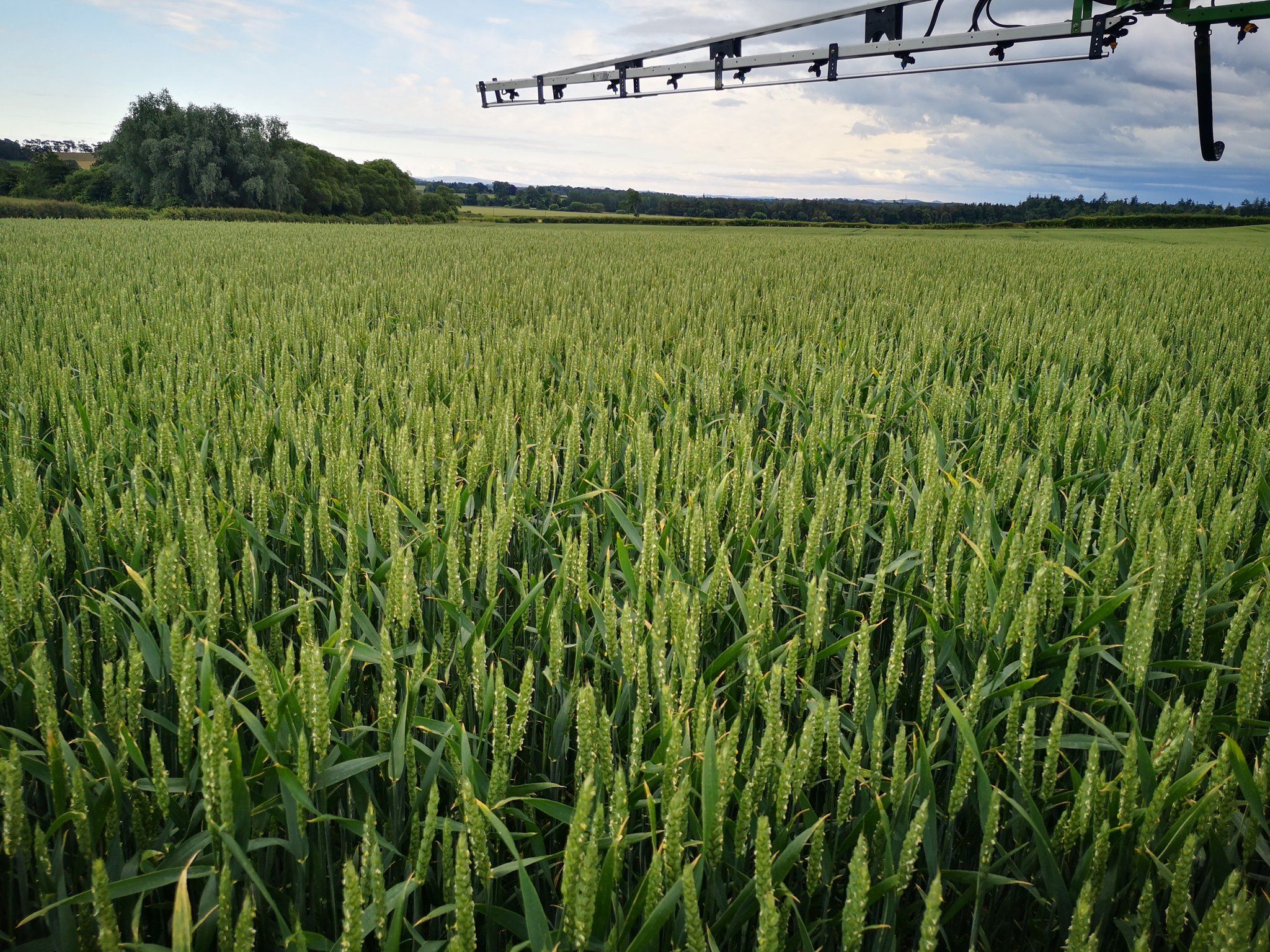
David Fuller-Shapcott farms Sweethope Farm at Bothwell near Kelso in the Scottish Borders and has been involved with numerous trials over the years to understand how he can improve the efficiency of his farming methods.
He has embraced data collection using surveys, GPS and AI and is reaping the rewards of acting on the knowledge it brings.
David is particularly interested in increasing the yield of wheat, barley and oilseed rape, as he has some challenging heavy clay loam soils.
He has been involved with the scientist-led yield enhancement network since its inception in 2014. This has taught him about crop structure and the capabilities of his ground and as a result he has got much better yields.
Most recently David has made his farm available to the scientists from SLIMERS – Strategies Leading to Improved Management and Enhanced Resilience against Slugs (run by the British On-Farm Innovation Network (BOFIN) to find new ways of dealing with the slug problem that is a product of warmer wetter climate.
He goes out once a week to monitor hundreds of slug traps, to check numbers, identify species and record the general slug activity. The key is to understand the variation in slugs and correlate this with the soil type so to enable a targeted approach to control to reduce the amount of pesticides used.
David's approach is all about overcoming the challenges presented to him by the heavy clay soil he cultivates.
He has discovered that by improving his knowledge of the ground he can work around what would traditionally have been insurmountable or accepted issues.
For example, soil surveys highlighted the soil was depleted in zinc which gave rise to semi fertile ears in wheat.
By correcting this the yields were improved, but to avoid reliance on chemicals he undertook trials with different seed treatments and now all his seeds are treated with a bio-stimulant to encourage early growth.
Such an approach means they are also helping the soil biology. He avoids using fungicides he does not want to affect the fungal populations in the soil.
Cost and carbon footprint implications are also challenging for farming today and to embrace this David has been involved with crop protection product specialist BASF trialling different products and rates which improves application efficiency. This involves the use of GPS and variable rate application technology.
David feels that gathering the data is the easy bit the real challenge is finding the time to properly interrogate what it is telling you.
The SLIMERS project is an example off taking a challenge head on and actively looking for solutions. AI is also used for slug identification while the survey data gives precise soil type detail.
The impact of embracing change as a result of developing a better understanding of his land through this data collection has been proven to help David achieve significant improvements in his yields on what is arguably a difficult farm.
In 2022 he was awarded bronze in the national ADAS YEN competition for his crop of oilseed rape, an increase on his 2019 award.
Furthermore, by taking part in these trials he is building the knowledge base that others will benefit from.
Hand-in-hand with improving soil health and increasing yields is David's passion for increasing biodiversity on the farm.
This is why the changes he implements are undertaken with one eye on the yield and the other on the potential unintended consequences of his choices on the soil and wider biodiversity.
He has worked with the Scottish rural development programme to provide cover cropping and developed field margins which has seen a big improvement in populations of ground nesting birds, such as grey partridge, lapwing, curlew and oystercatcher, plus recent sightings of wild quail.