

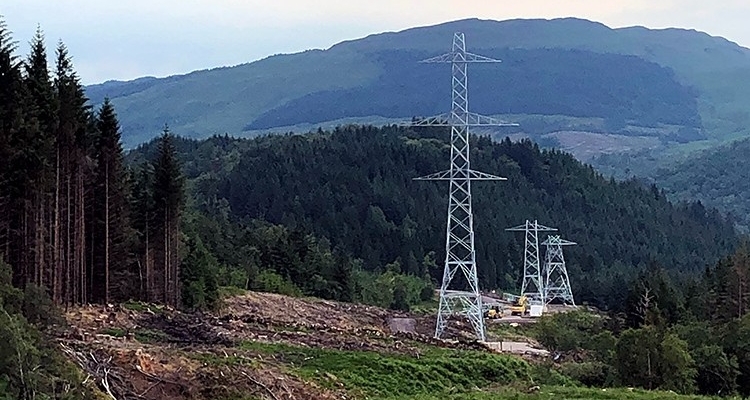
Guest blog: SSEN Transmission Capital Development & Delivery Projects: Forestry Management
Readers will already be aware that SSEN Transmission is in a period of extraordinary activity as we develop multiple transmission projects across our network area. As a transmission operator, we are responsible for the electricity transmission network in the north of Scotland, which extends over a quarter of the UK’s land mass, crossing some of its most challenging and diverse terrain.
As we continue with the replacement and reinforcement programme of our ageing network, we are also investing £20bn between now and 2030 to upgrade the network infrastructure across the north of Scotland, which is known as ‘The Pathway to 2030’. These projects include new substations, overhead lines, underground cables and subsea cables. This investment is critical to meeting Scotland and the UK’s renewable energy targets and allows us to maintain a safe and secure transmission network.
Whilst we try to avoid impacting forestry, in the locations where we are replacing and building new electrical infrastructure, inevitably our development projects will impact trees and woodland to a varying degree.
When developing infrastructure designs, particularly overhead lines (OHLs), we engage early with forestry landowners and then actively throughout the OHL alignment selection process to assess forestry impacts fully. We undertake detailed forestry assessments, usually as part of an Environmental Impact Assessment (EIA), which we use to inform our Operational Corridor (Wayleave) design through woodland.
This involves the following key elements:
• Discussion with landowners on their current forestry management strategy for their landholding, including reviewing Long Term Forest Plans (LTFPs)
• Woodland surveys and assessments
• Windblow risk assessments and mitigation design of felling boundaries
• Forest landscape design plans and impacts
• Tree crop and woodland volume assessments for valuation for compensation agreements
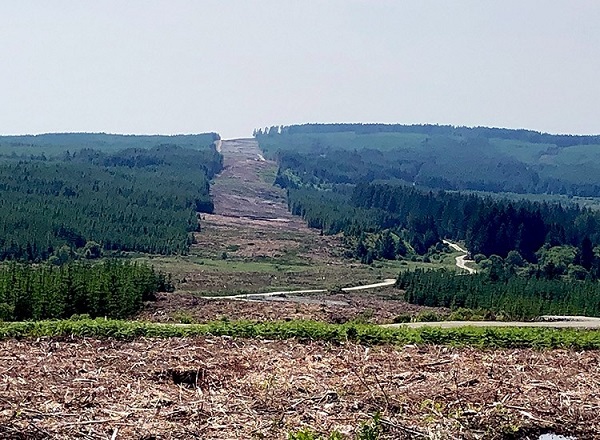 We aim to build positive relationships with landowners and agents throughout this process, right through to the forestry works completion. We recognise we are custodians of your land and are committed to undertaking forestry works to a high standard with competent and approved forestry contractors. The main forestry work undertaken is timber harvesting, mechanised mulching, motor manual chainsaw, arboriculture and where required, live line utility felling.
Some of the key forestry items on which we want to engage with forestry landowners and agents include:
• Our Grantors Charter - we provide indemnity for reasonable claims in the event of woodland windblow occurring within a period of 5 years as a result of tree cutting carried out by us. Through a responsible approach we look to mitigate windblow occurrence through our felling designs and compensate accordingly in agreement with landowners
• The landowner requirements of the Health and Safety Executive (HSE GS6) document and future machine crossing points under the new OHL
• Retention of permanent and potentially temporary (subject to landowner planning approval) project access tracks, for future benefit, for landowner access requirements and for timber haulage
• Through our Compensatory Planting Strategy, we are committed to replant every hectare of woodland we remove within our project footprint. Generally, this is new planting off-site from the OHL operational corridor, to maintain the safe energisation of our electrical infrastructure
We are working hard to ensure we develop projects with forestry best practice and landowners’ interests in mind and open and honest communication with landowners is essential. Should you wish to discuss any forestry matters with us please contact us at SHETLandTeam@sse.com.
Comments