

Scotland is a model for world-leading wildlife conservation, based on joined-up approach
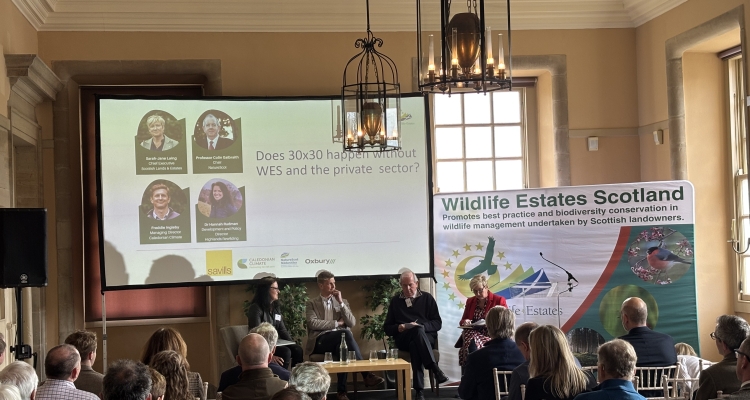
Press ReleaseScotland’s approach to conservation is a model for other nations to follow, delegates were told at the Wildlife Estates Scotland (WES) Assembly at Hopetoun House this week.
Land managers from across the UK and Europe joined conservationists, agricultural consultancies and rural business leaders to share best practice, evaluate the risks and opportunities of nature-based investment and reaffirm their commitment to nature.
Speakers at the event included Sarah-Jane Laing, chief executive of Scottish Land & Estates (SLE), Professor Colin Galbraith, chair of NatureScot, Jurgen Tack, secretary general of the European Landowners’ Organisation, Carolien Samson, head of sustainable banking at Oxbury Bank, Dr Hannah Rudman from Highlands Rewilding, Mark Cunliffe-Lister, owner of Swinton Estate in North Yorkshire, Alicia Clements, director of Wildlife Estates Ireland, Freddie Ingleby, managing director of Caledonian Climate and Lucy Jenner, head of natural capital consultancy at Savills, headline sponsor of the event.
The coveted Wildlife Estates accreditation is open to any size and type of landholding, farm, or estate. WES recognises and promotes exemplary sustainable land management that delivers demonstrable and lasting benefits for Scotland’s natural heritage, rural economy and communities.
WES is the national version of the European Wildlife Estates initiative, established in 2010 under the umbrella of the European Commission’s Directorate-General for Environment. The WES membership covers an area of 2.8 million acres.
Scotland is currently in second place in the league table of Wildlife Estates land in Europe, with only Spain ahead.
A new partnership between Wildlife Estates Scotland and Oxbury Bank was announced at the event. The Oxbury Transition Facility will enable WES members to secure flexible funding to help farmers manage cashflow and capital needs as they transition to lower-carbon, more resilient farming systems. The scheme incentivises farmers and land managers who are transitioning to agricultural methods that reduce carbon emissions, improve soil health and increase biodiversity.
Miles Montgomerie, chair of WES, said:
“Scotland is internationally recognised as a model of what’s possible when landowners, government and communities pull together. The extraordinary achievements of WES members are not only safeguarding the future of rare Scottish species, but also restoring wetlands, protecting rivers and planting thousands of acres of native trees. We have seen how active conservation enables much-loved species to thrive, with many mammals and birds now flourishing throughout Scotland. The work of many land owners often goes unrecognized as they strive to protect and enhance Scotland’s natural heritage.
“The next five years will show how we can deliver the thriving biodiversity and enhanced carbon capture that we all want to see – with strong government links and policy stability key to keeping up the momentum.”
This year marks a notable highpoint for WES, as Grosvenor’s Reay Forest Estate in Sutherland not only secured ‘gold’ level accreditation, the first landholding ever to do so, but also received the highest score achieved by any Wildlife Estates accredited organisation in Europe. Working in partnership with the Atlantic Salmon Trust (AST), the Estate plans to restore 118km2 of the landscape – an area the size of urban Manchester – with up to a million carefully selected trees being planted, enhancing biodiversity and benefitting the whole ecosystem.
The estate is also following a science led approach to deer management with the aim of supporting measurable improvements in biodiversity and habitat.
Objectives for the next five years for the WES scheme include recognition that it is the authoritative accreditation scheme for demonstrating sustainable land management that supports and enhances biodiversity. WES intends to foster close collaboration and deliver tangible value to a diverse range of landholdings.
Francesca Fowler-Walsh, associate natural capital consultant – Edinburgh, Rural and Projects at Savills, commented:
“Across estates, we are seeing a deep, long term commitment to improving soils, habitats and biodiversity through decisions that are grounded in science and informed by real data. This evidence based approach demonstrates that nature recovery and productive land use can genuinely advance hand in hand. As sponsor, we are pleased to support an initiative that highlights the power of collaborative, evidence-led land management to deliver meaningful environmental outcomes. Scottish estates are showing that when landowners, communities and government work together, the results can be transformative — not only for wildlife, but for the long term resilience and future of the land.”
WES members across all regions of Scotland are investing in major habitat improvement projects including woodland creation, peatland restoration, riparian tree planting, creation of wildflower meadows for insects, regenerative agriculture and protection of river ecosystems.
WES members also conduct extensive monitoring, species surveys, prolonged research projects and data recording, providing an invaluable long-term resource for policymakers and conservation organisations. Their interventions play a significant role in increasing the quality of our water catchments and the air we breathe.
Neil Gunn, WES Project Manager Scottish Land & Estates, commented:
“Over the past fifteen years vast projects have been undertaken to restore and improve a range of habitats, resulting in a turnaround for many vulnerable species in Scotland. The data gathered by WES members is vital – providing real-life insights into what works and what can be replicated by others. We look forward to the next fifteen years and the continued collaboration which has secured these incredible wildlife success stories.”