

Scotland’s rural businesses key to growth – but new course must be set on tax & regulation
Press ReleaseRural businesses can be a driving force in Scotland’s economic growth - but government must adopt a more ambitious and enabling approach if that potential is to be fully realised.
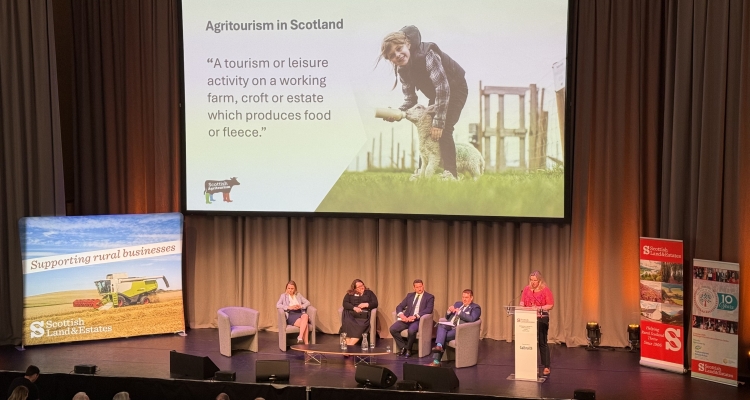
Rural business organisation Scottish Land & Estates held its annual conference today with a call for a more focused and practical approach to economic growth — one that recognises rural Scotland as central to the country’s future prosperity, rather than peripheral to national policymaking.
A key theme from the conference was the need for business ambition to be matched by a clear and enabling agenda from both the Scottish and UK governments. SLE said rural enterprises are ready to invest, innovate and expand, but need policy frameworks that increase confidence, remove unnecessary barriers and support delivery.
The organisation said getting that approach right would bring benefits beyond individual businesses - generating economic growth for government, creating jobs and prosperity for communities. Rural estates generate an estimated £2.4 billion GVA/year for the Scottish economy and support around 56,310 jobs.
SLE called on both the Scottish and UK governments to align policy decisions affecting rural businesses, warning that conflicting approaches risk deterring long-term investment.
Sarah-Jane Laing, chief executive of Scottish Land & Estates, said: “Rural businesses are no different from thousands of other businesses across Scotland and the UK: they want a platform for growth that allows them to invest, create jobs and get on the front foot, rather than feel government is holding back their potential.
“Politicians talk about cutting red tape, but for many rural businesses the burden is increasing, not reducing.
“It’s not one single bombshell that causes the problem; it’s death by a thousand cuts. Tax rises, energy costs and growing employment pressures are killing businesses and stifling ambition. We all recognise the pressures on public spending and the need to support households through the cost-of-living crisis. However, the answer cannot simply be to keep adding new costs and complexity onto businesses that are already under pressure.
“In Scotland, we have also seen businesses that have diversified to strengthen their income streams badly exposed by the recent non-domestic rates revaluation. That risks punishing the very enterprise and resilience that government says it wants to encourage.
“For years, we talked about the need to break down silos between different land uses in rural Scotland - farming, tourism, energy, forestry, natural capital and housing. Now, too often, it feels like the silos are in government. Individual decisions may be taken in isolation, but their combined impact on businesses, investment and confidence is not being properly joined up.
“Rural businesses are ambitious, resilient and deeply committed to the places in which they operate. They take a long-term view, planning not just for the next year, but for the next 20, 30 or 50 years. They see huge opportunities in the Scottish and UK economies, from food production and tourism to clean energy and natural capital.
“The challenge now is to create the right economic conditions for those businesses to flourish. If government sets a clear agenda for growth and works with rural businesses as partners in delivery, rural Scotland can play a major role in powering the economy.”
New SLE chairman, Patrick Colquhoun, also gave a passionate address about the forward-thinking role rural businesses can play in assisting government to achieve their objectives – and urged fellow business owners and operators to have confidence in their own potential.
Patrick Colquhoun, chairman of Scottish Land & Estates, said: "Our job is not to stand still and defend what exists - it is to help shape what comes next.
"Scotland is sitting on one of the great economic opportunities of our generation: extraordinary natural resources, world-class food and drink, a renewables sector leading the way, and tourism that draws visitors from every corner of the globe. The task now is to turn those strengths into lasting prosperity.
"If there is one word I want to define the next five to ten years, it is confidence - confidence in rural Scotland, confidence in the people who power it, and confidence that the strongest chapters of our story are still to be written.
"I know full well that running a rural business is no easy task. Layer upon layer of regulation, tax and barriers to investment send entirely the wrong signal. Too often, the people taking the risks that drive rural growth are made to justify their place in the economy rather than be recognised for what they bring to it.
"We have a new Scottish Government in place, and while we may not always sing from the same hymn sheet, we firmly believe SLE members can be the drivers of growth that help government deliver on its own ambitions. For too long, the rural debate has been framed by what we are told cannot be done. It is time to flip that on its head and talk seriously about what we can achieve when this country backs its own potential.
"When rural Scotland thrives, the whole of Scotland thrives. Our rural economies belong at the heart of the national story - not on its edges.
“That is why SLE is calling for a clear, joined-up economic strategy for rural Scotland, including stable tax policy, streamlined regulation and stronger support for investment in land-based industries. Getting the right policy framework will unlock investment, create jobs in rural communities and strengthen Scotland’s resilience in key sectors including food, energy and exports.”
Keynote speakers at the conference included Dr Savvas Savouri, Managing Director of QuantMetriks Research, who spoke on macro-economic opportunities for rural businesses; Rachel Ross, CEO of Elevator UK, who focused on entrepreneurship and starting a business in rural Scotland in 2026; and Emily Norton, Chair of the Agriculture and Horticultural Development Board, who discussed food, farming and natural capital.