

New Wildfire Partnership Urged After Green Cleugh Blaze Threatened Pentland Hills
Press ReleaseA formal wildfire partnership should be established across the Pentland Hills following a blaze that could have escalated from 17 hectares to a landscape-scale incident affecting more than 6,000 hectares, a new report has recommended.
The Green Cleugh Wildfire Debrief Report examines the response to the fire at Eastside Farm in the Pentland Hills during late May and identifies lessons for preventing and tackling future incidents.
Facilitated by Scottish Land & Estates (SLE), the report – which makes eight strategic recommendations - follows a debrief meeting at Easter Bavelaw Farm involving 32 representatives from land management, public agencies, emergency services, farming businesses, community groups and other organisations.
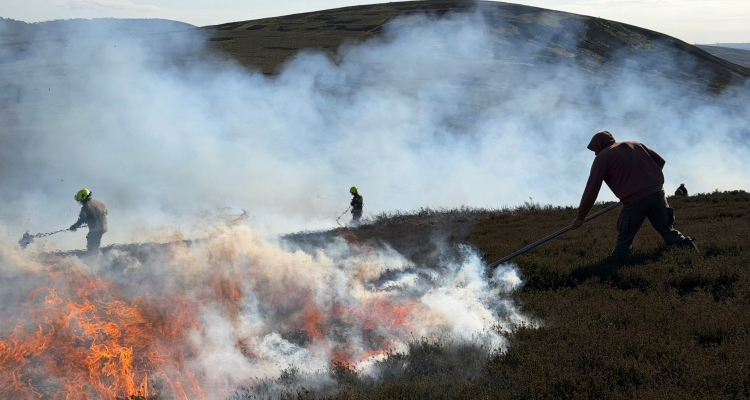
The wildfire was reported at around 4pm on 25 May, prompting the deployment of six SFRS appliances alongside local land managers, gamekeepers and Pentland Hills Regional Park staff. It was largely contained that evening, but smouldering peat, strong winds and dry conditions caused a significant re-ignition on 28 May. Fire watches, thermal drone surveys and work to extinguish hotspots continued until rainfall on 1 June helped bring the incident to an end.
Around 17 hectares of sensitive moorland habitat and grazing land were burned, representing approximately 31 per cent of the Pinnace heft grazing area. The fire occurred during the peak breeding season in habitat supporting red-listed bird species including curlew, merlin, ring ouzel, skylark and cuckoo. It also came within metres of recently established woodland creation sites in a wider 5,000-hectare biodiversity project area.
The response involved 10 estates, 16 gamekeepers, 14 farmers and seven Pentland Hills Regional Park rangers. The report records 30 individual volunteers contributing 397 hours, including six overnight fire-watch deployments.
All-terrain vehicles, tractors, water pumps, fogging units, fire beaters, water bowsers and other specialist equipment were brought to the scene. The debrief concluded that rapid intervention, local knowledge, specialist equipment and existing fuel management helped prevent the fire becoming substantially larger.
Scenarios considered during the meeting indicated that the fire could have spread across 560 hectares towards Black Hill, Gask Hill and Bells Hill, or across 1,070 hectares towards Carnethy and Scald Law. A landscape-scale incident following a change in wind direction could potentially have affected 6,120 hectares – approximately 61 per cent of the Pentland Hills Regional Park.
Ross Ewing, Director of Moorland & Strategic Projects at Scottish Land & Estates, said:
“The Green Cleugh wildfire demonstrated both the growing threat facing Scotland’s upland landscapes and the difference that a rapid, coordinated response can make.
“Firefighters were supported by people who work on this land every day and who brought detailed knowledge of the terrain, specialist equipment and practical wildfire experience. The report makes clear that this combined effort helped prevent a 17-hectare fire from developing into a potentially devastating landscape-scale incident.
“The recommendations are practical and deliverable. Establishing a Pentlands Wildfire Partnership, supported by a shared action plan, asset register and regular training exercises, would ensure everyone is better prepared before the next emergency occurs.
“Future land-use and environmental policies must also properly consider wildfire prevention and resilience. Fuel-load management, including lawful and responsible muirburn to create effective firebreaks, as well as practical access for suppression, must be part of how we protect these landscapes, their wildlife and neighbouring communities.”
Jenny Cowan of Eastside Farm said: “The initial fire was largely brought under control that evening, but the re-ignition three days later showed how long the danger can remain beneath the surface when peat is dry.
“People returned late at night and worked through until the early hours, while fire watches and work to find and extinguish hotspots continued for several days. We remain enormously grateful to every firefighter, farmer, gamekeeper, ranger and volunteer who gave their time and brought the equipment and experience needed to protect the wider Pentlands.
“We now need to turn these hard-won lessons into action. Better coordination, regular joint training, strategic management of fuels, clear access arrangements and shared knowledge of the people, water sources and equipment available would help everyone respond even more safely and effectively in future.”
The debrief also identified issues relating to Pentland Hills Regional Park communications during the incident, including concerns that public messaging was not always helpful, consistent or sufficiently evidence-led during a period of elevated wildfire risk. One of the report’s recommendations calls for wildfire messaging arrangements to be reviewed to ensure future public communications are timely, coordinated and clearly support incident response.
The report also highlights increasing concern about disposable barbecues and campfires in the Pentland Hills, although it does not identify the cause of the Green Cleugh wildfire.
The full Green Cleugh Wildfire Debrief Report can be read here: https://www.scottishlandandestates.co.uk/sites/default/files/library/20260729%20Green%20Cleugh%20Wildfire%20Debrief%20Report.pdf