

Vital contributions of Scotland’s rural estates recognised in Holyrood debate
Press ReleaseThe role of Scotland’s rural estates in driving local economic development, supporting the transition to net zero and providing homes and supporting community resilience has been recognised at Holyrood.
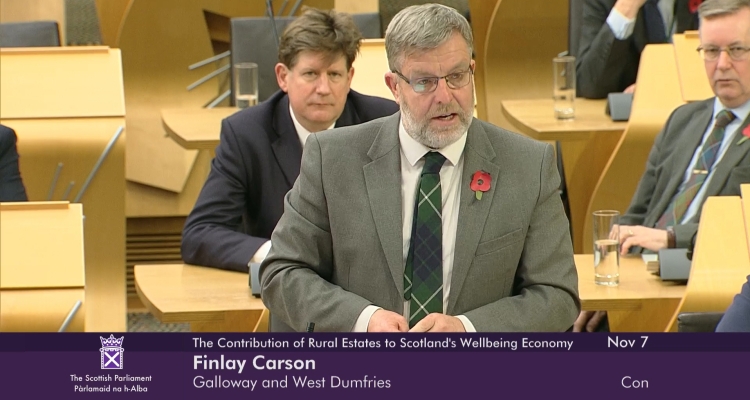
In a debate led on Tuesday evening (November 7, 2023) by Finlay Carson, Scottish Conservative MSP for Galloway and West Dumfries and Convener of Rural Affairs and Islands Committee, parliamentarians welcomed the publication earlier this year of a report entitled The Contribution of Rural Estates to Scotland’s Wellbeing Economy.
The report was authored by BiGGAR Economics, a leading consultancy providing economic analysis and advice for central and local government, educational institutions and private sector organisations across Europe. The research was commissioned by Scottish Land & Estates.
The research found that estates:
- Provide homes for 13,000 families and land for 14,000 rural enterprises.
- Attract an estimated 5.4 million Scottish residents annually to enjoy the natural environment.
- Account for 58% of Scotland’s renewable energy generating capacity.
- Make a substantial contribution to Scotland’s natural capital base through agricultural, forestry and renewable energy operations
- Are important for carbon sequestration potential and nature-based tourism
- Generate an estimated £2.4 billion GVA/year for the Scottish economy and support around 57,300 jobs – around 1 in 10 rural jobs.
- Have huge potential to help drive efforts to establish a wellbeing economy in Scotland and could be key delivery partners for a variety of related policy priorities.
A wellbeing economy is described as an economic system operating within safe environmental limits, that first and foremost serves the collective wellbeing of current and future generations. The Scottish Government has set 11 National Outcomes to measure progress towards a wellbeing economy, with the research finding that rural estates contribute to at least seven of these outcomes.
Sarah Madden, Policy Adviser (Rural Communities) at Scottish Land & Estates, said:
“The research by BiGGAR Economics demonstrates how Scotland’s estates are delivering for people, jobs and nature and we are delighted that parliamentarians have taken the opportunity to debate this research and thank them for their contributions, particularly to Finlay Carson MSP who brought this to the chamber.
“In the report, estates are described as ‘anchors for thriving communities’. It is crucial that this is recognised – only through prospering rural areas can we deliver across a wide range of sectors including food production, tourism and leisure, renewable energy, carbon sequestration and nature and biodiversity enhancement.
“By policymakers recognising this best practice, it can drive others to go even further and heighten the contribution being made. Brilliant work takes place every day on Scotland’s estates and we want to work with politicians from all sides to do more in future.”
Among the parliamentarians who spoke during the debate were Finlay Carson MSP, SNP’s Emma Harper MSP, Colin Smyth MSP from Scottish Labour and Scottish Government Minister for Energy and the Environment, Gillian Martin MSP.
Environment Minister Gillian Martin MSP said:
“I welcome the approach that was taken in the report commissioned by Scottish Land & Estates. “The Contribution of Rural Estates to Scotland’s Wellbeing Economy” sets out a positive vision of not only how rural estates contribute to Scotland’s rural economy but how they might support our transition to a wellbeing economy.
“During the summer, I visited a community energy operation in Penpont. Buccleuch Estates, as a partner, had given over the land for the generator, as well as access to the water that it owned. That is an example of an estate working with the local community for real benefit, and it was great to see it.”
Emma Harper MSP said:
“The jobs that are supported by rural estates sustain populations in some of our most fragile rural communities, but the contribution that estates make to rural communities is wider than that. The evidence that has been presented by Scottish Land & Estates shows that rural estates provide homes for around 8,250 private tenants and around 4,700 agricultural tenants across Scotland. Those homes underpin many rural communities, enabling people to live in parts of Scotland where housing options would otherwise be limited. Rural estates also lease land to around 1,400 crofters and farmers. Those enterprises form the backbone of many Scottish communities and therefore play an important role in creating the thriving resilient communities that are envisaged in the Government’s national outcomes framework.”
Colin Smyth MSP said:
“In my South Scotland region are positive examples of estates that provide diverse contributions, from the biodiversity improvements from new hedgerows, ponds and native woodland regeneration at the Roxburghe estate in the Scottish Borders to the positive tourism offer mentioned by Finlay Carson—everything from yoga to wellbeing retreats—at the Barwhillanty estate near Castle Douglas and the sustainable farming and food production that provides quality lamb and award-winning wool at the Castlemilk and Corrie estates near Lockerbie. The latter has strong ties with the local community through the Lockerbie Wildlife Trust, which manages the fantastic Eskrigg nature reserve. All three estates that I mentioned are important providers of affordable housing and vital jobs to their local rural communities.”
Finlay Carson MSP said:
“Estates generate an estimated £2.4 billion a year for the Scottish economy and support around 57,300 jobs—around one in 10 rural jobs—providing employment in areas where opportunities can be scarce. They provide high-quality jobs, paying on average 95 per cent of their staff at least a living wage, and 86 per cent of the positions are contractually secure.
“Estates have adopted a buy-local policy that makes rural economies more resilient, and improves the wellbeing of those who rely on them. On average, estates purchase almost three quarters of supplies from their local area. In turn, they support a healthy stream of business start-ups, which is a hugely important component of a thriving economy, especially when it involves young enterprises.
“There is clear evidence from the research that estates are agents for social, economic and environmental development, providing the kind of private investment that will allow the Scottish Government to deliver on its priorities. In the words of Shona Glenn of BiGGAR Economics: ‘The findings show that the contribution goes well beyond economic output and supporting jobs. Scotland’s estates are doing much to drive the creation of a wellbeing economy.’”
The full debate can be viewed here:
The Official Report from the debate can be read here: